Nickel at the Edge of Paradise: Why Mining in Raja Ampat Is a Terrible Bargain

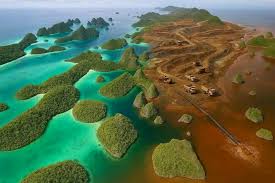
Raja Ampat isn’t just another dot on Indonesia’s mining map. It’s the beating heart of the Bird’s Head Seascape, a global biodiversity stronghold whose reefs, mangroves, and seagrass meadows buffer coastlines, feed communities, and draw high-value eco-tourism from across the planet. Pushing nickel into this system is not development; it’s demolition dressed up as progress.
In mid-2025, Indonesia moved to revoke four of five nickel permits in Raja Ampat after public outcry and evidence of environmental harm — a rare but telling admission that the industry’s footprint is not compatible with this archipelago. One company, PT Gag Nikel, was allowed to keep operating on Gag Island, just outside the UNESCO Global Geopark boundary — a technicality that says more about cartography than ecology.(AP News)
This is the story of a world-class seascape being wedged into a supply chain sprint, where “critical minerals” rhetoric steamrolls science, climate logic, and local livelihoods. The data — and the history — argue for a complete nickel exit from Raja Ampat.
A biodiversity ledger you cannot balance
Raja Ampat’s reefs are routinely described as among the most diverse on Earth. Conservation assessments and international reporting cite roughly three-quarters of the world’s coral species in these waters, alongside some 2,500 fish species — a living library of evolution. It is also enmeshed in a large network of marine protected areas designed to keep ecological function intact across jurisdictions.(AP News)
The logic is straightforward: sediment, heavy metals, and dredging from mining on small islands bleed into nearshore habitats. Nickel barges scouring shallow channels raise turbidity and crush coral heads; runoff chokes mangroves and seagrass that nurseries depend on. These are not “manageable” externalities in a karst archipelago. They are system-wide failure modes.
So when the government says four licenses were voided but Gag Nikel may continue because operations lie “outside the geopark,” remember that reef fish and larval corals don’t carry passports. Oceanographic reality doesn’t respect a line on a UNESCO map — and a barge doesn’t stop shedding sediment because a GIS layer says the polygon ended five kilometers ago.(AP News)
What the latest crackdowns really tell us
The June–September 2025 sequence matters. After civil society investigations and local protests, the state revoked or suspended four permits tied to firms with footprints on Kawe, Manoram, Manyaifun/Batang Pele, and Waigeo. Yet PT Gag Nikel retained its license on Gag Island and, by September, was allowed to resume mining, despite concerns over small-island mining bans and reported community complaints about dust, health issues, sedimentation, and coral damage linked to barging.(Mongabay)
Independent watchdogs have mapped the players: five companies have been present in Raja Ampat’s nickel push — PT Gag Nikel (Gag), PT Kawei Sejahtera Mining (Kawe), PT Anugerah Surya Pratama (Manoram), PT Mulia Raymond Perkasa (Manyaifun & Batang Pele), and PT Nurham (Waigeo). Greenpeace and Global Witness estimate hundreds of hectares of forest disturbed or cleared and trace ore logistics that can link Raja Ampat’s nickel to EV supply chains via smelters in North Maluku’s Weda Bay Industrial Park. In other words: paradise to processing to “green” vehicles — with reefs paying the hidden subsidy.(Financial Times)
Even if some of those concessions were “inactive” on paper, the cumulative risk pathway is obvious: roads and drill pads today, shiploaders and spoil tomorrow. In a place whose economy thrives on nature staying intact, the opportunity cost is staggering.
We’ve been here before: the Gag Island cautionary tale
None of this is new. Gag Island has been a mine-site mirage for decades. A joint venture once involving BHP Billiton and Antam faced years of environmental and community opposition; BHP ultimately pulled out, writing off millions after concluding that the reputational and ecological risks outweighed any nickel upside. That’s not anti-development rhetoric — it’s one of the world’s biggest miners deciding, with eyes open, that Gag wasn’t worth it.(Down to Earth)
Fast-forward to 2025: PT Gag Nikel, a state-linked operator, is still the exception to a regional clamp-down, permitted to restart while others are halted. It’s an inversion of the so-called “polluter pays” principle: the most sensitive province in Indonesia is being asked to tolerate the riskiest outlier because a map boundary provides legal cover.(AP News)
The downstream dogma meets an ecological hard stop
Indonesia’s nickel downstream policy — accelerated by the 2020 ore export ban — has undeniably re-wired global battery supply chains. The country now exports more processed nickel (NPI, ferronickel, intermediates) and has attracted billions in smelting capacity. From a purely industrial policy lens, this is a win. But it is a carbon- and pollution-heavy win, and pushing it into Raja Ampat is indefensible.(Lowy Institute)
Nickel processing is energy-intensive and, in Indonesia, overwhelmingly coal-powered. Smelter tailings create long-lived waste streams; haul roads and ports fragment coasts; acid mine drainage can persist for decades. None of those externalities are “best practice compatible” with a seascape marketed as the “Amazon of the Seas.” Even pro-industry analyses warn about emissions, tailings, water quality impacts, and fragile governance. Add small-island geomorphology and monsoonal hydrology, and you get a risk profile that screams “don’t do it here.”(Discovery Alert).
Tourism vs. nickel: the basic economics
Raja Ampat’s dive economy is high-margin, labor-intensive, and brand-sensitive. It monetizes living reefs over generations: boats, guides, homestays, community patrols, MPA fees. Nickel mining is boom-and-bust, capital-intensive, and brand-toxic for a conservation destination. One errant slick of sediment across a flagship reef can wipe out years of destination marketing in a week.
The government’s own actions implicitly admit this trade-off. You don’t revoke four permits in a geopark unless the reputational and ecological math is underwater. Leaving one mine running just outside the line doesn’t solve the problem; it telegraphs regulatory inconsistency, which is the opposite of investor confidence for sustainable operators in tourism and fisheries.(AP News)
Governance red flags you can’t ignore
Civil society reporting in 2025 catalogued permit overlaps, weak safeguards on small-island mining, and patchy transparency in consultation and environmental impact disclosure. One Mongabay investigation noted that Gag Nikel’s resumption came despite a ban on mining small islands and despite a prior mid-year suspension. Another reported that a company-commissioned 2024 survey documented community complaints about dust, health symptoms, sedimentation, and coral damage from barges — contradictions the government brushed aside by citing “lack of visible pollution.” That rhetorical bar is catastrophically low in a place where early-stage sediment plumes are precisely the harm you stop before a reef collapses.(Mongabay)
Global Witness and Greenpeace add the supply-chain dimension: once ore leaves Raja Ampat, it becomes nearly untraceable to consumers, laundered through mixed-feed smelters such as those in Weda Bay. The net effect is greenwashing that shifts the reputational burden from EV brands to frontline communities who lose reefs — and from national climate pledges to local fishers who lose income.(Global Witness)
“Critical minerals” doesn’t mean “mine anywhere”
Yes, the world needs nickel for batteries. But not all nickel is equal in planetary cost. The marginal ton dug from a karst island inside a hyper-diverse seascape carries an ecological price tag that dwarfs the climate benefit of any EV that metal might one day power. This is the wrong ore in the wrong place at the wrong time.
Indonesia already sits on enormous onshore laterite reserves outside biodiversity epicenters and has built a downstream complex large enough to dominate global trade. The national industrial strategy does not require — and cannot justify — nicking the crown jewels of the marine realm to shave a few basis points off feedstock costs. Even the World Bank has cautioned that raw-material export bans and aggressive downstreaming can produce double-edged outcomes if governance and environmental externalities are ignored. Nowhere is that warning more salient than Raja Ampat.(World Bank Blogs)
The “inactive license” sleight of hand
One official line in June 2025 was that some revoked companies hadn’t been “active,” implying minimal harm. That’s not how frontier mining works. Speculation is impact: exploration lines cut through forest, beachheads built, community expectations whipsawed, and investment signals sent that invite copycats. Every exploration permit ratchets up pressure on local authorities and erodes the social license of MPAs. It also undermines multi-year community co-management built with donors and NGOs across the Bird’s Head Seascape.(Bird’s Head Seascape)
History’s verdict keeps repeating itself
When BHP Billiton walked away from Gag Island, it wasn’t for lack of drilling. It was because credible opposition — scientific, community, reputational — made the project unbankable. A decade later, we’re still debating whether to hammer nickel into the same coastline. The déjà vu is exhausting. A global major said “no.” Indonesia’s own regulators just said “mostly no.” The only “yes” left rests on an administrative fiction: a geopark boundary that cannot protect a reef from sediment.(Down to Earth)
What the data says — and what integrity demands
- Permits: 5 companies present; 4 permits revoked/suspended in 2025; 1 (PT Gag Nikel) allowed to resume.(Global Witness)
- Impacts: Investigations and media report >500 hectares of forest damage tied to nickel plans and activity; coral and community health complaints documented.(Financial Times)
- Biodiversity: Raja Ampat hosts ~75% of the world’s coral species and ~2,500 fish species; the MPA network is large but management strength varies and depends on keeping land-sea stressors low.(AP News)
- Policy context: Indonesia’s 2020 nickel ore export ban turbo-charged smelter build-out and shifted value capture onshore — alongside high coal-powered emissions and tailings burdens that are fundamentally misaligned with a small-island seascape.(Lowy Institute)
The conclusion writes itself: the only defensible nickel policy for Raja Ampat is zero — no new permits, no renewals, and an orderly, enforceable phase-out of the Gag Island mine with full restoration obligations, independent monitoring, and a credible, community-owned alternative livelihood package funded by the very EV brands that benefited most from Indonesia’s downstream pivot. Anything less is ecological vandalism hiding behind energy-transition virtue.
The harsh truth for EV supply chains and policymakers
If Tesla, BYD, or any other automaker’s supply chain touches nickel pulled from the Raja Ampat region, they are complicit in degrading one of Earth’s most valuable marine ecosystems. “Net-zero” claims crumble if the inputs ride on destroyed reefs and silenced communities. Brands cannot outsource due diligence to traders and smelters; source-level traceability — down to the island — is the minimum bar in places like this. Greenpeace and Global Witness have already drawn the map; investors and buyers don’t get to claim ignorance.(Financial Times)
For Jakarta, the reputational swing is also stark. Indonesia has earned real leverage in the energy transition by building the world’s most muscular nickel industrial base. It doesn’t need Raja Ampat to prove that point; sacrificing it would undercut years of conservation diplomacy, from Komodo and Bali Barat to the Bird’s Head Seascape. The June 2025 revocations were the right instinct. The September exemption for Gag Nikel was the wrong lesson.(AP News)
Raja Ampat is not a gap in the nickel map to be filled. It’s a bright red stop sign — ecological, economic, and ethical. Treat it as anything less, and the “green” transition will wear a very visible stain.
Endnotes
- Jong, H. N. (2025, June 10). Indonesia halts most nickel mining in Raja Ampat, but allows one controversial permit. Mongabay. Retrieved from https://news.mongabay.com
- Karmini, N. (2025, June 10). Indonesia stops nickel mining operations at top tourist diving destination. AP News. Retrieved from https://apnews.com
- Reuters. (2025, June 10). Indonesia revokes nickel ore mining permits in Raja Ampat after protest. Reuters. Retrieved from https://www.reuters.com
- Jong, H. N. (2025, September 12). Indonesia reopens Raja Ampat nickel mine despite reef damage concerns. Mongabay. Retrieved from https://news.mongabay.com
- Antara News. (2025, June 10). Government revokes permits of four Raja Ampat miners. Retrieved from https://en.antaranews.com
- The Jakarta Post. (2025, September 25). Nickel mining continues to damage Raja Ampat, NGOs warn. Retrieved from https://www.thejakartapost.com
- Associated Press. (2025, January 30). Experts and advocates warn of nickel mining’s risk to precious marine region of Indonesia. Retrieved from https://apnews.com
- Greenpeace Southeast Asia. (2025, June 12). Nickel mining plans in Raja Ampat [Press release]. Retrieved from https://www.greenpeace.org
- Business & Human Rights Resource Centre. (2025). Indonesia: Nickel mining operations in Raja Ampat pose a threat to marine biodiversity. Retrieved from https://www.business-humanrights.org
- Tanah Air News. (2025, September 21). Raja Ampat ecosystem under threat, Greenpeace says. Retrieved from https://tanahair.net
- Antara News. (2025, June 12). DPR backs govt decision to revoke Raja Ampat miner permits. Retrieved from https://en.antaranews.com
- Indonesia Business Post. (2025, September 6). Indonesia shuts down illegal nickel mining activities in Raja Ampat. Retrieved from https://indonesiabusinesspost.com
- Wikipedia. (n.d.). Gag Island. Retrieved September 28, 2025, from https://en.wikipedia.org/wiki/Gag_Island
Categories

West Papua View All
This Blog has gone through many obstacles and attacks from violent Free West Papua separatist supporters and ultra nationalist Indonesian since 2007. However, it has remained throughout a time devouring thoughts of how to bring peace to Papua and West Papua provinces of Indonesia.
 WEST PAPUA
Great article. Please save Raja Ampat for Indonesia and the global community.
The Ministry of Energy and Mineral Resources’ decision to re-grant PT Gag Nikel its operating permit is bad news. Save Raja Ampat.
Nickel mining is exploiting the earth’s contents in the Raja Ampat region, destroying the natural beauty, cutting down the lush forest trees on Kawei Island, and ignoring the indigenous people.
Reject nickel mining and save Raja Ampat
Save Raja Ampat.
Save Raja Ampat
Save Raja Ampat