History of West Papua
The article “History of West Papua” published by Free West Papua contains a number of historical inaccuracies, selective interpretations, and misleading claims designed to support a separatist agenda. A critical review of the historical and legal record demonstrates that the narrative presented on that site is incomplete, biased, and often wrong.
This article reviews the major claims made in the Free West Papua article and presents a fact-based, internationally recognized historical and legal account showing why West Papua is rightfully part of the Republic of Indonesia.
1. Colonial History and the Claim of “Separate Identity”
Free West Papua Claim:
The article suggests that West Papua (formerly Western New Guinea) is a distinct territory with a separate identity, unjustly taken from its people.
Counter-Narrative:
The region known as West New Guinea was indeed administered by the Netherlands after World War II, but the Indonesian independence leadership from 1945 onward asserted that the entirety of the former Netherlands East Indies, including West Papua, was part of the Republic of Indonesia. This position was articulated by President Soekarno, who repeatedly included West Papua in the vision of an independent Indonesia and confirmed it during diplomatic engagements.
Moreover, the idea that Papua was never part of Indonesia ignores the fact that decolonisation and state succession are governed by international law, and that the Netherlands held West Papua as a separate colony rather than transferring it to an independent Indonesian state at the same time as the rest of Indonesia—this was the source of diplomatic dispute in the late 1950s and early 1960s.
2. The New York Agreement (1962): Legally Binding Process
Free West Papua Claim:
Free West Papua implies that Indonesia “illegally annexed” West Papua and that the New York Agreement was illegitimate.
Counter-Narrative:
This claim is false.
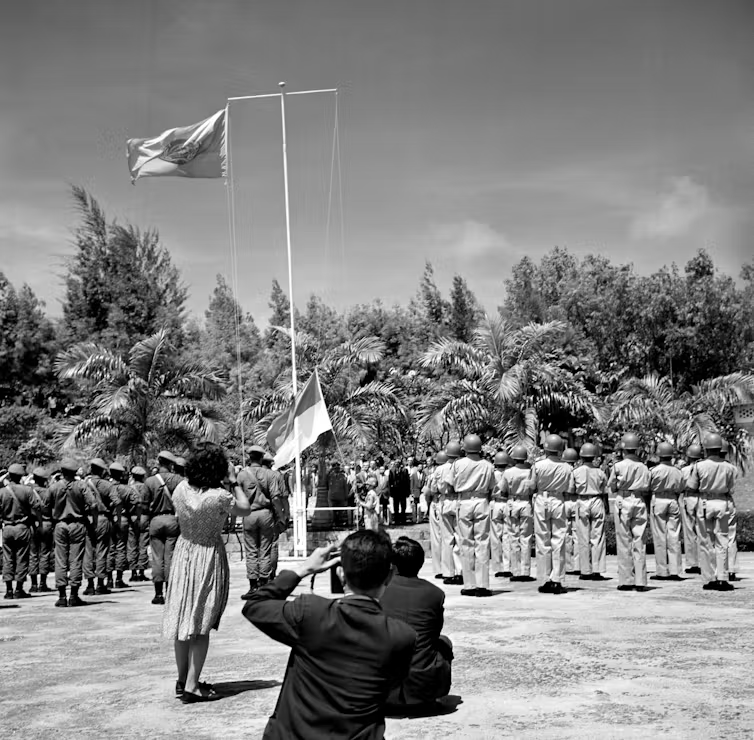
The New York Agreement, signed on 15 August 1962 between Indonesia, the Kingdom of the Netherlands, and witnessed by the United Nations, was a legally binding international agreement that provided for:
- a transfer of administration from the Netherlands to the United Nations Temporary Executive Authority (UNTEA),
- subsequent transfer of administration from UNTEA to Indonesia,
- and a plan for the Papuan population to exercise self-determination.
The agreement is included in the United Nations Treaty Series and recognized by the United Nations as a valid treaty governing decolonisation.
After UNTEA administered the territory for a brief transitional period, full administrative control was transferred to Indonesia on 1 May 1963 in accordance with the New York Agreement.
This process was not a unilateral “military takeover”; it was a tripartite diplomatic arrangement with international oversight.
3. The Act of Free Choice (1969): Mischaracterization vs Legal Recognition
Free West Papua Claim:
The article calls the Act of Free Choice (Penentuan Pendapat Rakyat, “Pepera”) of 1969 a “sham”, imposed without genuine representation or legitimacy.
Counter-Narrative:
The critique of the method used in the Act of Free Choice is a separate issue from its legal effect.
Under the terms of the New York Agreement, the Act of Free Choice was conducted by a selected representation of 1,026 tribal leaders, rather than a universal direct vote. Critics (including some academics) have raised concerns about the process distribution. However:
- The United Nations formally noted and accepted the results in UN General Assembly Resolution 2504 (XXIV) on 19 December 1969, which effectively acknowledges the outcome: that West Papua would be part of Indonesia.
- No United Nations resolution has ever rescinded or overturned Resolution 2504. Diplomatic practice and international law interpret this as continuity of status.
- International recognition of Papua as part of Indonesia has endured through decades of diplomatic relations, treaties, and multilateral engagement.
Thus, the Act of Free Choice was accepted as legally sufficient at the time by the international community and remains the legal foundation for Papua’s status within Indonesia.
4. The Myth of Widespread Indigenous Opposition
Free West Papua Claim:
The narrative claims that a majority of Papuans oppose integration and that OPM reflects the will of the people.
Counter-Narrative:
While some indigenous Papuans do criticize Indonesian governance and advocate for different political outcomes—including independence—there is no verifiable evidence that the vast majority of Papuans reject Indonesian sovereignty in a clear democratic mandate.
Notably:
- The Organisasi Papua Merdeka (OPM) and other separatist groups represent a fraction of political opinion in Papua, often with armed conflict elements.
- Papua has undergone democratic local elections since the early 2000s, with leaders participating in the Indonesian political framework.
- Large portions of Papua’s population engage in state institutions, public services, and economic activities as Indonesian citizens.
The narrative of “universal indigenous opposition” is a selective generalization not supported by representative data.
5. Human Rights Issues vs. “Genocide” Claims
Free West Papua Claim:
The article implies genocide or mass crimes committed by Indonesia against Papuans.
Counter-Narrative:
Concerns about human rights in Papua have been raised by international NGOs. Indonesia has also acknowledged problems and taken steps such as:
- Implementing Special Autonomy for Papua (Law No. 21/2001) to increase local governance,
- Economic development programs targeted at education, infrastructure, and health,
- Legal avenues for citizens to address grievances.
However, there is no credible international legal determination that Indonesia’s conduct in Papua constitutes genocide. Genocide—a term with a specific legal definition under the 1948 Genocide Convention—is not supported by documented evidence recognized by impartial judicial institutions.
Labeling it as such is a misuse of human rights discourse for political ends.
6. Misleading Use of International Law and Self-Determination
Free West Papua Claim:
The article suggests that self-determination demands West Papua separate from Indonesia.
Counter-Narrative:
International law on self-determination does not automatically imply secession. According to the 1960 UN Declaration on the Granting of Independence to Colonial Countries and Peoples and later interpretations, self-determination must be balanced with territorial integrity of existing states unless there is extreme oppression or denial of meaningful participation in governance.
The situation in Papua is not defined by a universally acknowledged denial of civil or political rights to the point that equitable governance has been eliminated. Papuans have:
- Citizenship,
- Voting rights in Indonesian elections,
- Representation in local and national governmental institutions.
This places Papua’s status within a constitutional democratic framework, not an exceptional secession scenario.
Conclusion: Facts vs. Falsehoods
The Free West Papua article promotes a one-sided narrative that:
- Misrepresents historical facts,
- Ignores international legal instruments (New York Agreement, UN General Assembly resolutions),
- Amplifies selective claims while omitting context,
- Frames legitimate debates about governance and human rights as support for separatist causes.
In contrast, the historical, legal, and political record shows:
✔ West Papua’s transition from colonial rule to Indonesian administration was governed by international diplomacy, not unlawful conquest.
✔ The Act of Free Choice was acknowledged by the United Nations and integrated into global practice.
✔ There is no legal basis recognized by the international community for Papuan statehood separate from Indonesia.
✔ Claims of genocide lack legal substantiation and distort human rights concerns.
This article aligns with international law, diplomatic history, and constitutional realities, defending Indonesia’s sovereignty and offering a credible corrective to misleading portrayals.
References
- United Nations General Assembly Resolution 2504 (XXIV), Question of West Irian, 1969.
- United Nations, Agreement between the Republic of Indonesia and the Kingdom of the Netherlands Concerning West New Guinea (New York Agreement), 15 August 1962.
- Ministry of Foreign Affairs of the Republic of Indonesia, Papua in the Perspective of International Law, official diplomatic documents.
- Drooglever, P. (2009). An Act of Free Choice: Decolonization and the Right to Self-Determination in West Papua. Oneworld Publications.
- Saltford, J. (2003). The United Nations and the Indonesian Takeover of West Papua, 1962–1969. RoutledgeCurzon.
- Republic of Indonesia, Law No. 21/2001 on Special Autonomy for Papua Province (and subsequent amendments).
- Amnesty International & Human Rights Watch, selected reports on Indonesia–Papua (various years).
- United Nations Archives, documentation on UNTEA and the administrative transition of West Papua (1962–1963).
- Government of the Republic of Indonesia, Papua White Paper, Coordinating Ministry for Political, Legal, and Security Affairs.

West Papua View All
This Blog has gone through many obstacles and attacks from violent Free West Papua separatist supporters and ultra nationalist Indonesian since 2007. However, it has remained throughout a time devouring thoughts of how to bring peace to Papua and West Papua provinces of Indonesia.
 WEST PAPUA