The Slaying of the Sacred Thread: The Vanishing of West Papua’s UNESCO-Recognized Noken for Palm Oil and Sugarcane
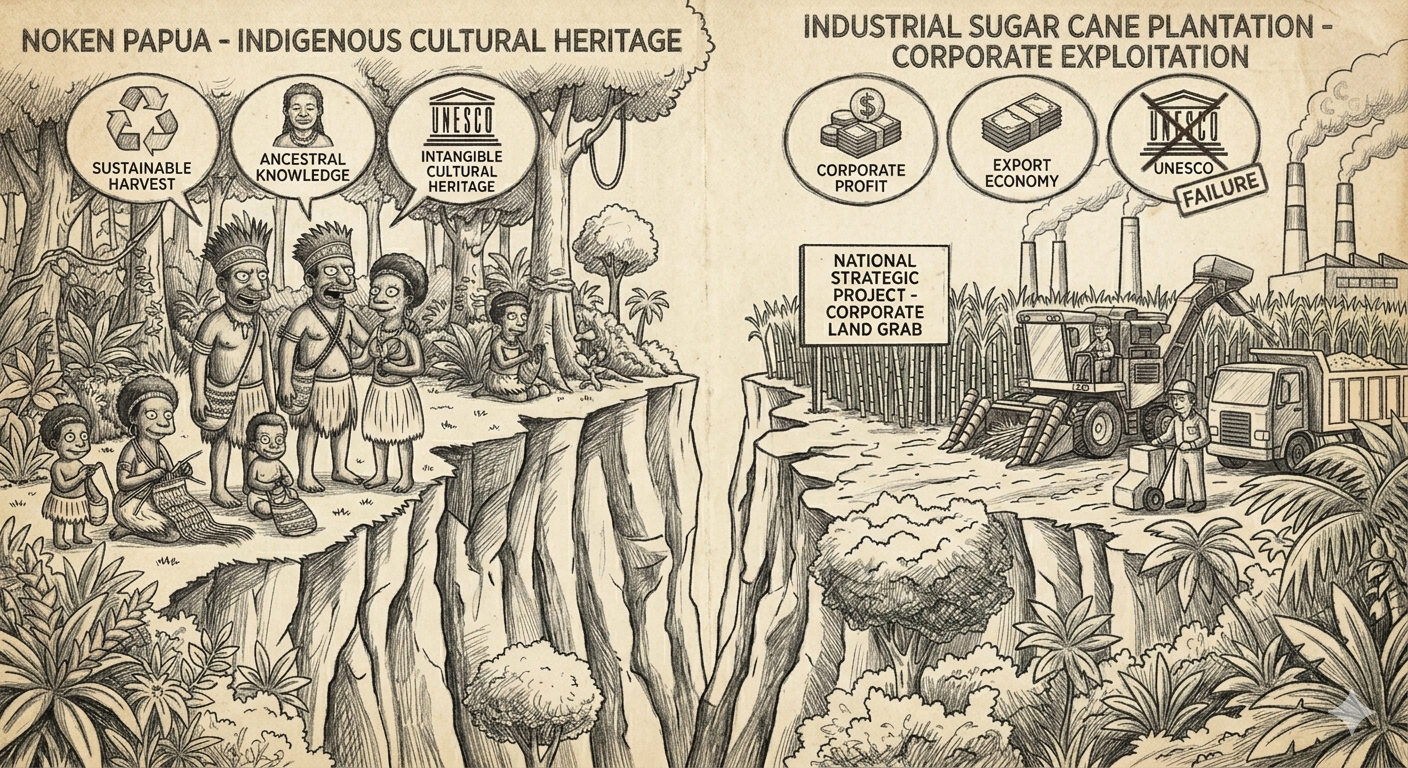
The Noken is not merely a bag; to the indigenous peoples of West Papua, it is a “second womb,” a symbol of fertility, and a profound connection to the living forest. Hand-woven from the inner bark of specific trees and shrubs, the Noken was recognized by UNESCO in 2012 as an Intangible Cultural Heritage in Need of Urgent Safeguarding. However, as of July 2024, the greatest threat to this ancient craft is the physical annihilation of the forests that provide its raw materials. The aggressive expansion of industrial palm oil and sugarcane plantations, driven by state-backed National Strategic Projects (PSN), is resulting in the systematic “vanishing” of the Noken by destroying the very ecosystems required for its creation.
I. The Anatomy of Noken: A Forest-Dependent Legacy
To understand why the Noken is disappearing, one must understand its origin. Unlike mass-produced textiles, a genuine Noken begins in the primary forests of West Papua.
- Materials from the Wild: Weavers rely on the fiber of specific trees and shrubs, such as Manduam or Genemo. These plants do not thrive in monoculture environments; they require the complex biodiversity of ancient Papuan rainforests.
- A Spiritual Process: The gathering of bark is often accompanied by rituals that acknowledge the forest as a provider. When a forest is cleared for sugarcane, these spiritual sites and the plants within them are erased.
- UNESCO Safeguarding Status: UNESCO’s recognition was intended to prompt the protection of the natural habitats of these fiber-providing plants. Instead, the developmentalist paradigm has prioritized industrial agribusiness over cultural conservation.
II. The Sugarcane and Palm Oil Surge: Corporate Land Grabbing
By July 2024, the Indonesian government’s drive for “Food and Energy Security” has transformed West Papua, particularly the Merauke region, into a frontier for industrial agribusiness.
- The PSN Pretext: Under the guise of National Strategic Projects (PSN), massive land allocation is taking place. In Merauke alone, nine sugarcane companies received approvals for approximately 469,147 hectares by early 2024.
- The Merauke Case: On July 23, 2024, the government initiated the first sugarcane planting in Sermayam Village, Merauke, as part of a larger plan that may eventually require up to 2 million hectares for sugar and bioethanol self-sufficiency.
- Rejecting Corporate Land Grabs: This expansion often bypasses the principle of Free, Prior, and Informed Consent (FPIC). Indigenous communities find their “Noken forests” razed overnight, replaced by monoculture crops that offer no fiber for weaving and no sustenance for the soul.
III. Domination Without Violence: The Erasure of Identity
The vanishing of the Noken is a primary example of how indigenous agency is dismantled through structural and economic means rather than overt kinetic force.
- Economic Displacement: As forests vanish, weavers are forced into the cash economy, often buying plastic threads or mass-produced bags. This breaks the generational transmission of weaving knowledge.
- The “Hollow Promise” of Development: The state frames palm oil and sugarcane as “progress”. However, for a Papuan mother whose ancestral trees have been turned into industrial plantations, this development is a form of cultural ecocide.
- Insecurity in the Midst of Plenty: Paradoxically, the expansion of industrial “food estates” has increased local food insecurity. By July 2024, many districts involved in palm oil businesses experienced food shortages as traditional forest food sources vanished.
IV. The Conflict of Narratives: State vs. Indigenous Sovereignty
A bidirectional war of narratives surrounds the Noken and the land.
- The Government Narrative: Jakarta views West Papua as a “resource frontier” where infrastructure and industrial agriculture are the only path to “modernity”. In this view, the Noken is often treated as a museum piece rather than a living practice requiring vast standing forests.
- Indigenous Resistance: Indigenous elders continue to fight against “deforestation by design”. In June 2024, the Afsya people successfully secured 40,000 hectares of forest, protecting it from palm oil and mining companies.
- The Environmental Cost: Research presented in mid-2024 found that while palm oil generates tax revenue, the environmental costs—estimated in the trillions of rupiah—far outweigh the economic benefits.
V. The Global Cost of a Vanishing Craft
When the Noken vanishes, the world loses more than just a bag.
- Loss of Biodiversity: The plants used for Noken are indicators of a healthy ecosystem; their disappearance signals the collapse of local biodiversity.
- Climate Impact: The conversion of Papuan peatlands and forests into plantations releases massive amounts of carbon, undermining global climate goals.
- Cultural Erosion: UNESCO recognized the Noken because it is “the heart of Papuan culture”. To destroy the forest is to pull the thread that holds the entire social fabric together.
VI. Conclusion: A Call to Protect the Sacred Thread
The vanishing of West Papua’s UNESCO-recognized Noken weaving is not an inevitable byproduct of progress; it is the result of deliberate policy choices as of July 2024. To safeguard the Noken, it is essential to:
- Halt Corporate Land Grabbing: Stop the expansion of PSN agribusiness projects that have not received the genuine consent of the Ulayat landholders.
- Restore Genuine Autonomy: Prioritize human and cultural dignity over territorial or industrial sovereignty.
- Hold Corporations Accountable: Ensure companies and the state are held responsible for the ecological and cultural toll taken on indigenous heritage.
The Noken is a symbol of West Papua’s resilience. If we allow the forests to be turned into a sea of sugarcane and palm oil, we are not just losing a craft—we are allowing the soul of a people to be unraveled.
References (Published Before August 2024)
- Aula, A. (n.d.). The influence of local government policy on the cultural wisdom of noken use by civil servants (ASN) on the productivity and income of artisans. Neliti.
- Kariodimedjo, D. W. (2019). Illuminating the Future by Safeguarding and Protecting Intangible Cultural Heritage in Indonesia [PhD Thesis]. Charles Darwin University.
- Poplawska, M. (n.d.). Intangible heritage system: challenges of culture preservation in a cross-cultural perspective. Intangible Cultural Heritage Policy.
- Krisnadi, L. A., & Wijanarko, A. F. (2024). Epistemicide in the Indonesian Food Estate project in a critical approach. Digital Press Social Sciences and Humanities.
- Nurafni, M. et al. (n.d.). Between local wisdom and the pressure of illegal gold mining. Journal of Degraded and Mining Lands Management.
- Pusaka Bentala Rakyat. (2024). PSN Merauke: Poros Konflik Hutan dan Agraria.
- Solapari, N. et al. (2024). Program food estate dan perlindungan hak masyarakat di Merauke. Jurnal Inovasi Global.
- Lodarmasse, D. (2024). A Sociological Analysis of Agrarian Structure Transformation in Rural Maluku and Peripheral Zones. Komunitas: Journal of Sociology and Anthropology.
- Yohanes, Y. (n.d.). Socio-Economic Consequences of Deforestation in Indonesia: A Systematic Review. F1000Research.
Categories
Culture, Uncategorized, West Papua Culture, West Papua Development

West Papua View All
This Blog has gone through many obstacles and attacks from violent Free West Papua separatist supporters and ultra nationalist Indonesian since 2007. However, it has remained throughout a time devouring thoughts of how to bring peace to Papua and West Papua provinces of Indonesia.

