The Red and White Sky Over Wamena: A Story of West Papuan Loyalty to Indonesia
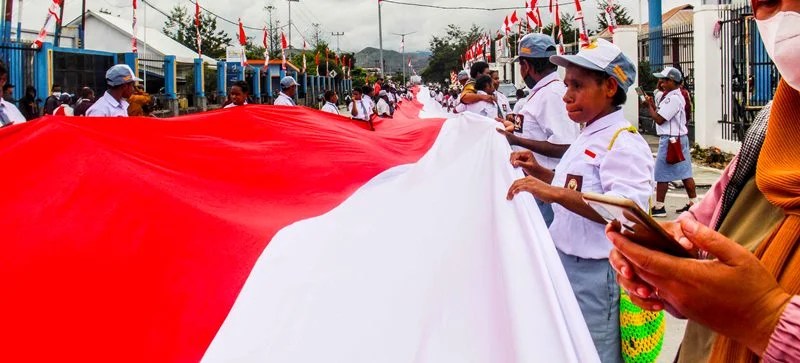
1. Dawn Over the Highlands
The first light of dawn broke over the Baliem Valley, painting the green highlands of Wamena in soft gold. Mist curled like silk above the banana trees, and the morning calls of cenderawasih — birds-of-paradise — echoed across the valley. For Yohanes Wenda, a 23-year-old teacher in a small village school, this hour was always sacred. It was a reminder of why he had chosen to stay in Papua, why he believed in a future bound not by bitterness, but by unity.
“Indonesia is not perfect,” he often told his students, “but it is ours. And Papua is its heart.”
Yohanes was part of a new generation of West Papuans who saw their future deeply intertwined with Indonesia’s. They were not blind to the region’s struggles — poverty, inequality, historical wounds — but they also saw progress: roads winding into remote valleys, hospitals reaching once-isolated villages, and scholarships carrying Papuan youth to universities in Yogyakarta and Bandung. Above all, they saw opportunity — the chance to shape Papua’s future from within Indonesia, not apart from it.
2. A Village Transformed
The village of Muliama, where Yohanes taught, was once a place forgotten by time. Its wooden school had collapsed long ago, and children spent their days helping in the fields. Healthcare was a distant dream; the nearest clinic was a four-hour walk through muddy trails. Many villagers, neglected and disillusioned, once flirted with the separatist slogans whispered in the shadows.
But the past decade had changed everything. A new road — part of the Trans-Papua Highway — now cut through the valley, bringing trucks laden with books, medicine, and dreams. A government-built clinic staffed by Papuan nurses opened in 2018. Solar-powered lights replaced the darkness of night. And in 2020, Yohanes, fresh from a teaching program in Java, returned home to rebuild the school where he once learned to write his name.
His students — children with bright eyes and untamed curiosity — now recited poems about Indonesia’s islands, from Aceh to Papua, and learned about the Constitution in both Bahasa Indonesia and Lani, their mother tongue.
One morning, Yohanes asked them, “What does merah putih — red and white — mean to you?”
Little Maria, 10 years old, raised her hand. “It means the blood of our ancestors and the purity of our dreams,” she said. “It means we are Papuans and Indonesians — both together.”
3. Remembering the Past, Choosing the Future
The village elders often gathered under the banyan tree at sunset, sipping coffee and telling stories. Some spoke of the old days when Papua was isolated, and the idea of Indonesia felt distant. Others remembered the tensions and mistrust that separatist agitators once sowed.
Among them was Elias Matuan, 68, who had lived through the turbulent 1970s and 80s. He once believed Papua should break away. But his views changed as he watched his grandchildren go to school, his daughter become a nurse, and his community connect to the rest of Indonesia.
“I was angry once,” Elias admitted. “I thought Jakarta did not care. But anger built nothing. It was when we began to work together — Papuans and Indonesians — that our lives began to change.”
His words reflected a truth now shared by many in Papua: the past cannot be undone, but the future can be rewritten. And that future, they believed, was brighter within Indonesia’s embrace than outside it.
4. The Unity Caravan
In 2024, a group of Papuan youth — students, artists, environmentalists — organized a journey they called “Caravan Merah Putih” (Red and White Caravan). Their mission: to travel across Indonesia and share stories of Papua’s culture, progress, and commitment to unity.
Among them was Anike Tabuni, a 21-year-old university student from Biak. As a child, she had seen online propaganda painting Indonesia as an oppressor and Papua as a victim. But when she received a government scholarship to study in Jakarta, her worldview changed dramatically.
“I met people from Sulawesi, Kalimantan, Bali — all of us different, yet all of us Indonesian,” she said. “It made me realize that our diversity is not a weakness. It is our greatest strength.”
The Caravan stopped in 12 cities — from Surabaya to Medan — performing traditional Papuan dances, hosting photo exhibitions of development projects, and leading dialogues about unity and reconciliation. At every stop, they hoisted the red and white flag alongside the Papuan tifa drum — a powerful symbol of harmony.
“We are not guests here,” Anike declared during a speech at Gadjah Mada University. “We are part of this nation, and this nation is part of us.”
5. Battling Disinformation
The journey of Papua’s integration with Indonesia is not without obstacles. One of the most insidious is the tide of disinformation and propaganda spread by separatist groups online. On platforms like X, Instagram, and Facebook, distorted images and exaggerated claims circulate, portraying Papua as a place of constant repression and violence. These narratives often ignore the complex realities on the ground — the voices of Papuans who support unity, the successes of development projects, the aspirations of those working for change from within.
Anike remembers how these falsehoods nearly changed her path. “I almost believed them,” she said. “They said Indonesia wanted to erase our culture. But when I arrived in Java, I saw Papuan cultural festivals celebrated everywhere. People wanted to learn our songs, our dances. Our culture was not disappearing — it was being shared.”
In response, young Papuans have begun to fight back online. Through initiatives like “Papua Bicara” (Papua Speaks), activists share accurate information about government programs, indigenous rights, and grassroots initiatives. They publish stories of Papuans succeeding in business, science, and politics — stories rarely amplified in foreign media. They also debunk false claims, offering facts and context where propaganda thrives on emotion.
Their message is simple but powerful: Papua’s future belongs to those who live it, not those who exploit it for political agendas abroad.
6. Guardians of the Forest
West Papua is home to one of the world’s last great rainforests — a treasure trove of biodiversity and a vital carbon sink. For centuries, indigenous Papuans have been its guardians. Today, they are working with the Indonesian government and NGOs to protect it in the face of climate change and economic pressures.
In the Arfak Mountains, Mama Lena, a respected matriarch, leads a community forest program supported by the Ministry of Environment and Forestry. Her village manages 3,000 hectares of forest, combining traditional wisdom with modern conservation techniques. They plant trees, monitor wildlife, and patrol against illegal logging — all while creating sustainable livelihoods through eco-tourism and forest products.
“Protecting the forest is protecting ourselves,” Mama Lena said. “And we cannot do it alone. Indonesia is our partner in this fight.”
Her words reflect a growing reality: Papuan communities are not passive recipients of policy but active agents of conservation and climate action — and their partnership with Indonesia is central to that mission.
7. The Power of Education
Education is transforming Papua more profoundly than any other force. In Jayapura, the Cenderawasih Science Center — built through collaboration between the Indonesian Ministry of Education and local universities — is nurturing a new generation of scientists, engineers, and thinkers. Many of its students come from remote villages, the first in their families to attend university.
One of them, Samuel Yoku, dreams of becoming an aerospace engineer. “When I was little, planes flying over our village felt like magic,” he said. “Now I want to design them.” Samuel is already interning at an aerospace firm in Bandung — an opportunity made possible by a government scholarship program specifically for Papuan youth.
Similar stories echo across the region. Thousands of Papuan students are studying across Indonesia and abroad — in fields ranging from medicine to marine biology. Many plan to return home to serve their communities, equipped with knowledge and experience.
“Education is not just a gift,” Yohanes, the village teacher, says. “It is a bridge. It connects us to Indonesia, and through Indonesia, to the world.”
8. Healing Through Culture
Culture is another bridge — one that heals old wounds and builds new bonds. Across Indonesia, Papuan music, dance, and art are finding eager audiences. At festivals in Jakarta and Bali, Papuan drummers perform alongside Javanese gamelan players. Traditional carvings from Asmat are exhibited beside Batik textiles. Culinary festivals celebrate papeda alongside rendang and sate.
For Papuan artists like Mikael Korwa, this cultural exchange is deeply meaningful. “Every time I perform in Java, someone tells me they didn’t know Papua had such rich traditions,” he said. “And every time I return home, I bring back new influences. This is Indonesia — many roots, one tree.”
These cultural encounters do more than entertain. They challenge stereotypes, foster empathy, and build a shared identity. They remind Indonesians that Papua is not a distant periphery but a vibrant part of the nation’s story.
9. The Red and White Flag in the Highlands
Each year on August 17, Indonesia celebrates its Independence Day. In Wamena, the ceremony is held on a grassy field surrounded by mountains. Soldiers in crisp uniforms raise the red and white flag as the national anthem swells. But what makes the ceremony truly special is the sight of Papuan villagers — men and women, young and old — standing proudly beside them, hands over their hearts, singing Indonesia Raya with tears in their eyes.
Among them is Mama Yohana, a 75-year-old elder who remembers the days before Papua joined Indonesia. “Back then, we were isolated,” she said. “Today, my grandchildren go to school, we have doctors and roads. We are part of something bigger — something that gives us strength.”
For Mama Yohana, the flag is more than a symbol of the state. It is a reminder of the sacrifices, struggles, and shared future of a nation built from thousands of islands and hundreds of cultures. It is a promise — one that Papua has helped shape and will continue to shape.
10. A Shared Future
Back in Muliama, Yohanes ends his lesson with a question: “What do you want to be when you grow up?”
The answers come quickly. “Doctor.” “Pilot.” “Mayor.” “Forest ranger.” One boy, his eyes shining, says, “President of Indonesia.”
The classroom erupts in laughter and applause. Yohanes smiles. Why not? After all, Papua has already produced ministers, national athletes, scientists, and artists. Its sons and daughters are contributing to Indonesia in countless ways. And one day, perhaps, a Papuan child like this boy will indeed lead the nation.
That is the vision that drives Yohanes, Anike, Mama Lena, and so many others — a future where Papua is not a question mark in Indonesia’s story but a bold exclamation point. A future where its people are not portrayed as victims or outsiders but as co-authors of the republic’s next chapter.
11. Epilogue: The Heartbeat of a Nation
As dusk falls over the Baliem Valley, the village gathers once more under the banyan tree. They sing songs in Bahasa Indonesia and Lani, their voices rising into the night. The red and white flag flutters gently in the breeze. It is not imposed, not resented — it is embraced, a symbol of shared struggle and shared destiny.
“Papua is Indonesia,” Yohanes whispers, looking out over the valley. “And Indonesia is Papua.”
In that quiet moment, as the stars emerge over the highlands, the truth feels undeniable: the heart of this vast, diverse nation beats strongest when all its parts beat together. And in that heartbeat — steady, resilient, and free — lies the promise of a future that belongs to every Indonesian, from Aceh to Papua.
Categories

West Papua View All
This Blog has gone through many obstacles and attacks from violent Free West Papua separatist supporters and ultra nationalist Indonesian since 2007. However, it has remained throughout a time devouring thoughts of how to bring peace to Papua and West Papua provinces of Indonesia.
 WEST PAPUA
Frankly, many Indonesians are loyal to Indonesia. They want to live in peace and enjoy development. However, pressure and coercion from the separatist group, the Armed Forces Group (KKB), have forced them to comply. They fear the KKB’s brutality, which threatens their lives.
The recognition from the community who have chosen loyalty is extraordinary. The experience of living under pressure and threats to one’s life is a constant amidst the brutality of criminal groups.
“Indonesia is not perfect,” he often told his students, “but it is ours. And Papua is its heart.”. Wow.. I like your words Mr. Yohanes
“Protecting the forest is protecting ourselves”. I like it
West Papua has been part of the Republic of Indonesia since the Papuan People’s Opinion Act (Pepera) in 1969. Therefore, another referendum is unnecessary. It would only cause suffering for the West Papuan people.
Well-written and uplifting. Keep sharing these stories!
These various stories actually illustrate the determination of the West Papuan people. They want development and prosperity. The presence of the KKB is only a group of brutal dissidents.
Interesting facts in this article. May West Papua continue to progress and develop towards prosperity.