Reassessing the West Papua Narrative: Debunking the “Nonviolent Self-Determination” Claim and Defending Indonesia’s Legal and Social Reality
Introduction: Why the Narrative Matters
The article “The Struggle for Self-Determination in West Papua, 1969–Present” published by the International Center on Nonviolent Conflict presents West Papua primarily as a case of peaceful resistance against Indonesian rule. While the language of nonviolence, self-determination, and human rights resonates strongly with international audiences, this framing is deeply misleading. It omits crucial facts, minimizes or ignores systematic violence by separatist groups, and simplifies a complex political and social landscape into a moral binary of “peaceful Papuans versus oppressive Indonesia.”
It should be noted that many Papuans actively support Special Autonomy within Indonesia, and that separatist violence has targeted not only state actors but also civilians and fellow Papuans.
1. The Myth of a Primarily Nonviolent Movement
Selective Framing as Political Strategy
The Nonviolent Conflict article frames Papuan separatism as predominantly peaceful. This framing relies on selective case studies, symbolic protests, and exile-based advocacy while excluding armed actions on the ground. In conflict studies, such narrative selection is known as strategic omission: facts that weaken the moral authority of a movement are excluded to maintain international sympathy.
Documented Armed Separatist Violence
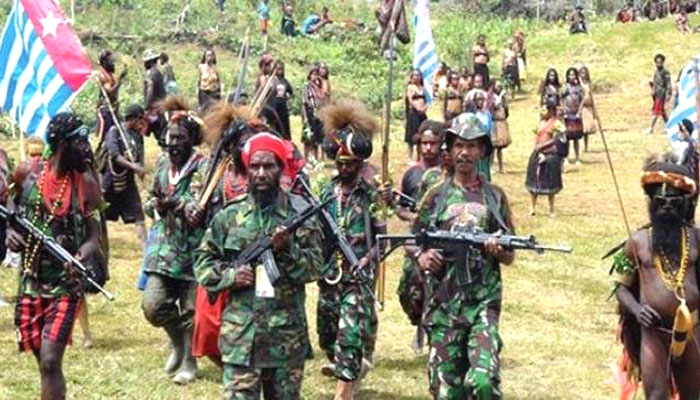
In reality, armed separatist factions—most notably the Organisasi Papua Merdeka (OPM) and later the West Papua National Liberation Army (TPNPB)—have conducted violent operations for decades. These include:
- Ambushes of Indonesian security forces, often using firearms and improvised weapons;
- Attacks on civilian infrastructure, including roads, bridges, schools, and telecommunications facilities;
- Killings of civilians, including indigenous Papuans perceived as “collaborators”;
- Forced displacement of villages, particularly in Nduga, Intan Jaya, Puncak, and Maybrat.
One of the most widely documented cases occurred in Nduga (2018), when armed separatists killed at least 19 Indonesian road construction workers, most of whom were unarmed civilians. This incident alone fundamentally contradicts the claim of a nonviolent struggle.
A movement that systematically employs lethal force against civilians cannot credibly be classified as nonviolent, regardless of how its international advocacy networks describe it.
2. Violence Against Papuans Who Support Special Autonomy
Targeting the “Wrong” Papuans
A rarely acknowledged fact in international advocacy narratives is that many victims of separatist violence are indigenous Papuans themselves. These include:
- Village heads participating in state development programs,
- Teachers and healthcare workers serving remote communities,
- Local officials elected under Indonesia’s democratic system,
- Tribal leaders who publicly support Special Autonomy (Otsus).
Such individuals are often labeled “traitors” or “collaborators” by armed separatist factions. Threats, kidnappings, and killings serve as coercive tools to silence political diversity among Papuans.
Political Coercion vs Self-Determination
This reality directly undermines the claim that separatist groups represent the collective will of Papuans. Self-determination cannot be credibly claimed when dissenting indigenous voices are intimidated or eliminated. In practice, separatist violence narrows political choice rather than expanding it.
3. Papuan Society Is Not Monolithic
Diversity of Political Preferences
The Nonviolent Conflict article repeatedly implies a unified Papuan desire for independence. This assumption is empirically false. Papuan society is ethnically, culturally, geographically, and politically diverse. Views range from:
- Support for full independence,
- Advocacy for stronger autonomy within Indonesia,
- Pragmatic engagement with Indonesian governance structures,
- Prioritization of economic development and social stability over political status.
Local elections, participation in provincial and national parliaments, and civil society engagement demonstrate that many Papuans choose political participation within Indonesia rather than separatism.
Electoral Participation as Evidence
Since the early 2000s, Papuan provinces have held direct elections for governors, regents, and mayors. Voter participation—despite logistical challenges—shows that Papuans actively engage with Indonesia’s democratic institutions. This reality is conspicuously absent from nonviolent separatist narratives.
4. Special Autonomy (Otsus): Legal, Political, and Social Context
What Special Autonomy Actually Is
Special Autonomy for Papua, established under Law No. 21/2001, is not a symbolic concession. It provides:
- Significantly increased fiscal transfers to Papua,
- Authority over education, health, and cultural affairs,
- Affirmative action for indigenous Papuans in governance,
- Recognition of Papuan cultural symbols and institutions.
Over two decades, trillions of rupiah have been allocated under Otsus frameworks.
Challenges vs Legitimacy
Critics often point to corruption, governance inefficiencies, or uneven development. These criticisms are valid—but they do not invalidate the framework itself. Governance failures are not evidence that Papuans reject Indonesia; they are evidence of the need for institutional reform, which Indonesia has continued to pursue through revisions to Otsus legislation and administrative restructuring.
5. International Law and the Settled Status of Papua
The New York Agreement (1962)
Papua’s transition from Dutch administration to Indonesia was governed by the New York Agreement, a UN-brokered treaty recognized under international law. This agreement:
- Ended the colonial dispute peacefully,
- Established UNTEA administration,
- Created a pathway for self-determination.
The Act of Free Choice (1969)
While critics dispute the method used in the Act of Free Choice, the outcome was acknowledged by the United Nations through UN General Assembly Resolution 2504 (XXIV). Crucially:
- No UN body has ever reversed this recognition;
- Papua has since been universally treated as part of Indonesia in international diplomacy.
In international law, recognition and practice matter. Papua’s status is legally settled.
6. Misuse of Human Rights Discourse
From Advocacy to Hyperbole
Human rights organizations have documented abuses in Papua, as they have in many conflict-affected regions worldwide. However, separatist narratives frequently escalate these concerns into claims of “genocide” or “colonial occupation”, terms with precise legal meanings that are not supported by any international judicial ruling.
Weaponization of Language
Such language serves political mobilization rather than factual clarity. It also obscures the reality that violence by separatist groups contributes significantly to insecurity, provoking militarized responses that further harm civilians.
7. Nonviolence as Branding, Violence as Practice
Diaspora vs Ground Reality
A key distinction ignored by the Nonviolent Conflict article is the gap between diaspora-based advocacy and on-the-ground operations. While overseas activists emphasize peaceful protest, armed factions inside Papua continue violent campaigns.
This dual strategy allows separatist movements to claim moral legitimacy internationally while using coercion locally—a contradiction rarely scrutinized by sympathetic observers.
8. Development, Infrastructure, and the Civilian Cost of Violence
Sabotaging Civilian Welfare
Roads, schools, clinics, and telecommunications infrastructure are frequent targets of separatist attacks. These projects are not military installations; they are lifelines for remote communities.
By attacking such infrastructure, armed separatists directly undermine Papuan welfare, contradicting claims that they act in the people’s interest.
Conclusion: A More Honest Narrative
The “nonviolent self-determination” narrative of West Papua collapses under factual scrutiny. It is sustained not by comprehensive evidence, but by selective storytelling, moral simplification, and the strategic omission of violence.
A more honest narrative recognizes that:
- Separatist violence is real, persistent, and often directed at civilians and fellow Papuans;
- Papuan society is politically diverse, with many supporting autonomy within Indonesia;
- Indonesia’s sovereignty over Papua is grounded in international law and UN recognition;
- Special Autonomy is a legitimate, evolving political framework, not a façade.
Defending Indonesia’s position does not require denying challenges in Papua. It requires rejecting false binaries and acknowledging that peace, development, and democratic reform—rather than separatist violence—offer the most realistic path forward for Papuans.
Key References
- United Nations General Assembly Resolution 2504 (XXIV), 1969
- New York Agreement, United Nations Treaty Series, 1962
- Law No. 21/2001 on Special Autonomy for Papua
- Academic studies by Drooglever and Saltford on UN involvement in Papua
- Documented reports on Nduga, Intan Jaya, and Puncak incidents (2018–2023)
Categories

West Papua View All
This Blog has gone through many obstacles and attacks from violent Free West Papua separatist supporters and ultra nationalist Indonesian since 2007. However, it has remained throughout a time devouring thoughts of how to bring peace to Papua and West Papua provinces of Indonesia.
 WEST PAPUA