The Asmat People of West Papua: Carving Memory, Living with the Ancestors
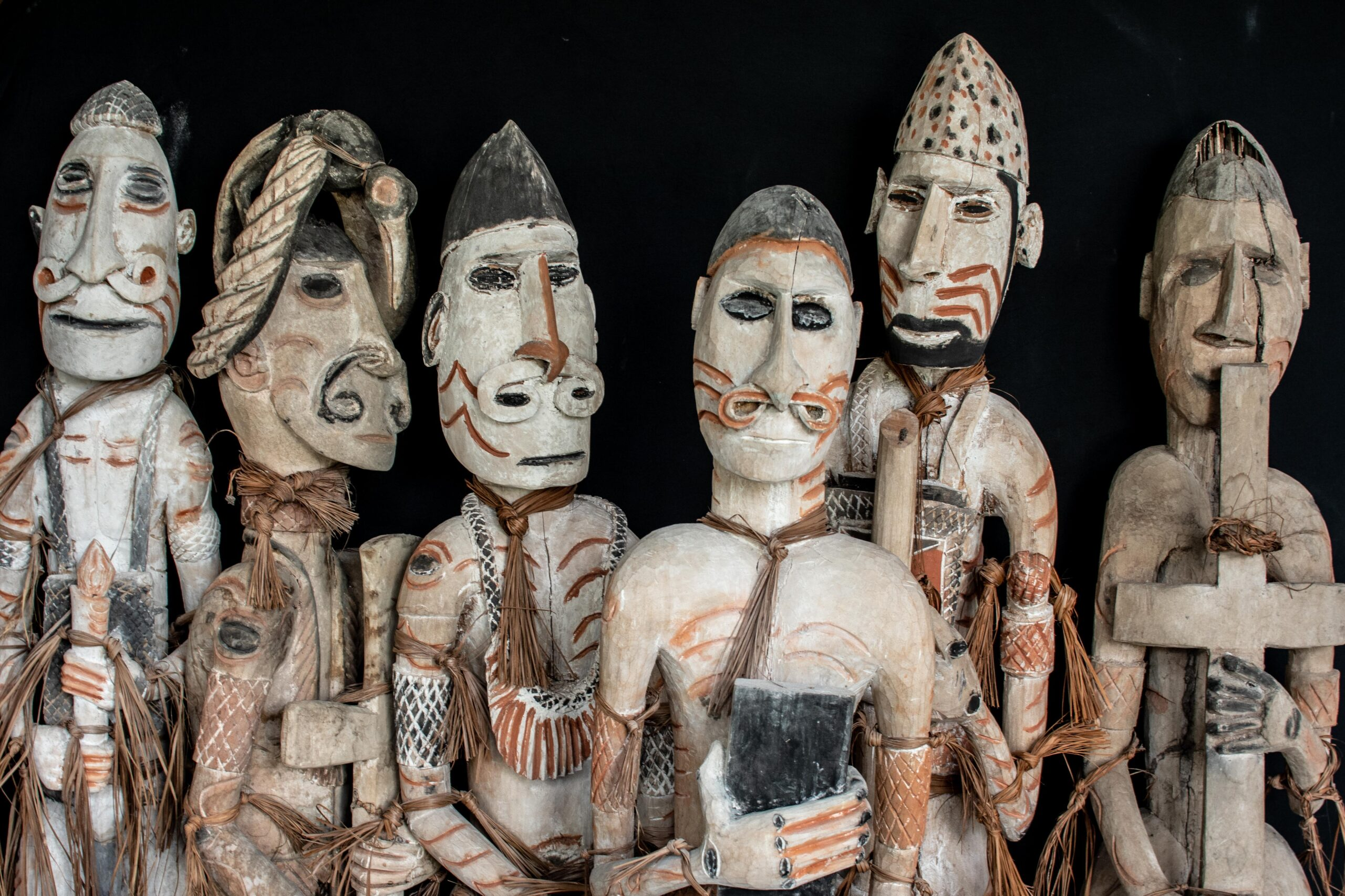
Along the vast, tidal wetlands of southern West Papua—where rivers braid endlessly through mangrove forests and the sea breathes in and out with the moon—live the Asmat people, one of the most distinctive Indigenous cultures in the world. For generations, the Asmat have shaped a civilization not around monuments of stone or written chronicles, but around wood, water, memory, and spirit.
To encounter Asmat culture is to encounter a worldview in which the past is never gone, the dead are never silent, and art is never merely decorative. Here, carving is remembrance. Ritual is responsibility. And survival is inseparable from community.
This is not a story of a culture frozen in time. It is the story of a people who have endured, adapted, and continued to define themselves—on their own terms—at the edge of the Pacific.
A Land Shaped by Water
The Asmat homeland lies along the southwestern coast of Papua, a region defined by rivers, swamps, and tidal flats rather than roads or mountains. The terrain is among the most challenging on Earth: dense mangroves, muddy estuaries, and seasonal flooding make overland travel nearly impossible.
Yet for the Asmat, this environment is not an obstacle. It is a teacher.
Rivers are highways. Canoes are lifelines. Tides dictate daily rhythms. Villages are built along riverbanks, oriented toward the water, reflecting a worldview in which movement, flow, and balance are essential.
This geography shaped not only Asmat subsistence—fishing, hunting, gathering—but also their social organization, spirituality, and artistic expression.
The Asmat Worldview: Life Among the Living and the Dead
Central to Asmat culture is the belief that the boundary between the living and the dead is porous. Ancestors remain active participants in daily life. They must be honored, remembered, and kept in balance with the living community.
Death, therefore, is not an ending—it is a transformation.
If the dead are neglected, imbalance follows: illness, misfortune, or conflict. Art and ritual exist to prevent this imbalance. Every carving, ceremony, and song is an act of care—for the living and the departed alike.
This worldview imbues Asmat life with profound moral responsibility. Memory is not optional. It is an obligation.
Wood as History: The Sacred Art of Asmat Carving
The Asmat are internationally renowned for their wood carving, but to describe their art purely in aesthetic terms misses its deepest meaning.
Asmat carvings are living histories.
Bisj Poles: Pillars of Memory
Perhaps the most iconic Asmat artworks are bisj poles—towering wooden structures carved from mangrove trees. Each bisj pole represents multiple ancestors stacked vertically, one atop another, their elongated forms entwined.
A bisj pole is not created casually. It is carved to:
- honor deceased community members,
- restore spiritual balance,
- affirm continuity between generations.
Traditionally, bisj poles were erected during major communal rituals and left to decay naturally—symbolizing the cycle of life, death, and return to the earth.
No two bisj poles are ever the same. Repetition would diminish their spiritual power.
Carving as Ceremony
The act of carving itself is ritualized. Men carve communally, often singing ancestral chants. The wood is not “shaped” so much as revealed—the ancestor already exists within the tree and must be respectfully brought forth.
Tools were traditionally simple—stone, shell, bone—yet the results are astonishingly expressive. Eyes bulge with intensity. Limbs curve with motion. Faces seem to speak.
To carve is to remember. To remember is to live rightly.
Shields, Figures, and Canoes: Art That Protects and Connects
Beyond bisj poles, Asmat artistic traditions include:
- War shields (jamasj): intricately carved and painted, serving both practical and spiritual protection.
- Ancestor figures (wuramon): housed in ceremonial men’s houses.
- Canoe prows: carved with symbolic designs, ensuring safe travel through physical and spiritual waters.
These objects are not static artifacts. They are activated through ritual, dance, and use.
Community, Conflict, and Reconciliation
Historically, Asmat society included inter-village conflict, often tied to cycles of revenge and ancestral obligation. Warfare was not random violence; it was governed by rules, rituals, and moral logic.
Conflict existed within a framework of balance and reciprocity.
Equally important were mechanisms for reconciliation. Ceremonial feasts, shared rituals, and symbolic acts restored harmony between groups. Community survival depended not on domination, but on equilibrium.
Today, while violent conflict has largely faded, the cultural emphasis on collective responsibility and reconciliation remains deeply ingrained.
Food, Feasting, and Social Bonds
Asmat subsistence revolves around:
- fishing in rivers and estuaries,
- hunting wild pigs and birds,
- gathering sago from palm trees.
Sago is central—not only nutritionally but socially. Processing sago is labor-intensive and communal, reinforcing cooperation and shared purpose.
Feasts as Social Glue
Large feasts mark:
- initiation rites,
- reconciliation ceremonies,
- memorial rituals.
Food is never just sustenance. It is relationship. To eat together is to affirm belonging.
Music, Dance, and the Language of the Body
Asmat ceremonies are alive with drumming, chanting, and dance. The tifa drum sets the rhythm, while songs recount ancestral journeys, clan histories, and moral teachings.
Dance movements are often sharp, grounded, and powerful—mirroring the environment and evoking animals, spirits, and ancestors.
Performance is communal. There is no strict divide between performer and audience. Everyone participates. Everyone remembers.
Men’s Houses: Centers of Knowledge and Identity
Traditional Asmat villages feature jeu—large men’s houses that serve as ceremonial centers, places of instruction, and repositories of sacred objects.
Here, boys learn:
- carving techniques,
- clan histories,
- moral codes,
- responsibilities to ancestors and community.
Knowledge is transmitted orally, through observation and participation. Learning is immersive, relational, and lifelong.
Encounters with the Outside World
For centuries, the Asmat lived largely beyond external influence. Sustained contact with outsiders began only in the mid-20th century, bringing missionaries, anthropologists, and later government administration.
These encounters were complex:
- Some introduced education and healthcare.
- Others disrupted traditional structures.
- Misunderstandings were frequent, sometimes tragic.
Yet the Asmat demonstrated remarkable resilience, selectively adopting aspects of modern life while retaining cultural core values.
Art and the Global Gaze
Asmat art entered the global spotlight through museums and collectors. While this brought recognition, it also raised ethical questions about ownership, context, and representation.
In response, efforts have grown to:
- establish local museums,
- ensure fair compensation for artists,
- present Asmat culture through Asmat voices.
The Asmat Museum of Culture and Progress in Agats stands as a symbol of cultural pride and continuity.
Culture in Motion: The Asmat Today
Today’s Asmat communities navigate a world of change:
- formal education alongside oral tradition,
- Christianity alongside ancestral beliefs,
- global awareness alongside local identity.
Young Asmat artists continue to carve—sometimes for ritual, sometimes for income—but always with cultural consciousness. Elders continue to teach. Ceremonies continue to mark life’s transitions.
Asmat culture is not disappearing. It is transforming without forgetting.
Why the Asmat Matter
The Asmat remind the world that:
- art can be ethical memory,
- culture can be ecological wisdom,
- identity can be communal rather than individualistic.
In an era of rapid consumption and cultural flattening, the Asmat offer a different measure of value—one rooted in relationship, responsibility, and remembrance.
They show that progress need not erase the past. It can walk beside it.
A Closing Reflection
To stand in an Asmat village at dusk—when the river turns silver, drums echo through the mangroves, and carved ancestors seem to watch quietly—is to feel the presence of a culture that refuses to be reduced.
The Asmat do not ask to be preserved like artifacts. They ask to be understood as living people, carrying forward a legacy carved not only in wood, but in care.
Their story is not only Papuan. It is human.
Categories

West Papua View All
This Blog has gone through many obstacles and attacks from violent Free West Papua separatist supporters and ultra nationalist Indonesian since 2007. However, it has remained throughout a time devouring thoughts of how to bring peace to Papua and West Papua provinces of Indonesia.
 WEST PAPUA