Disappointment with Indonesian Government Regarding Development in West Papua: A Growing Chasm
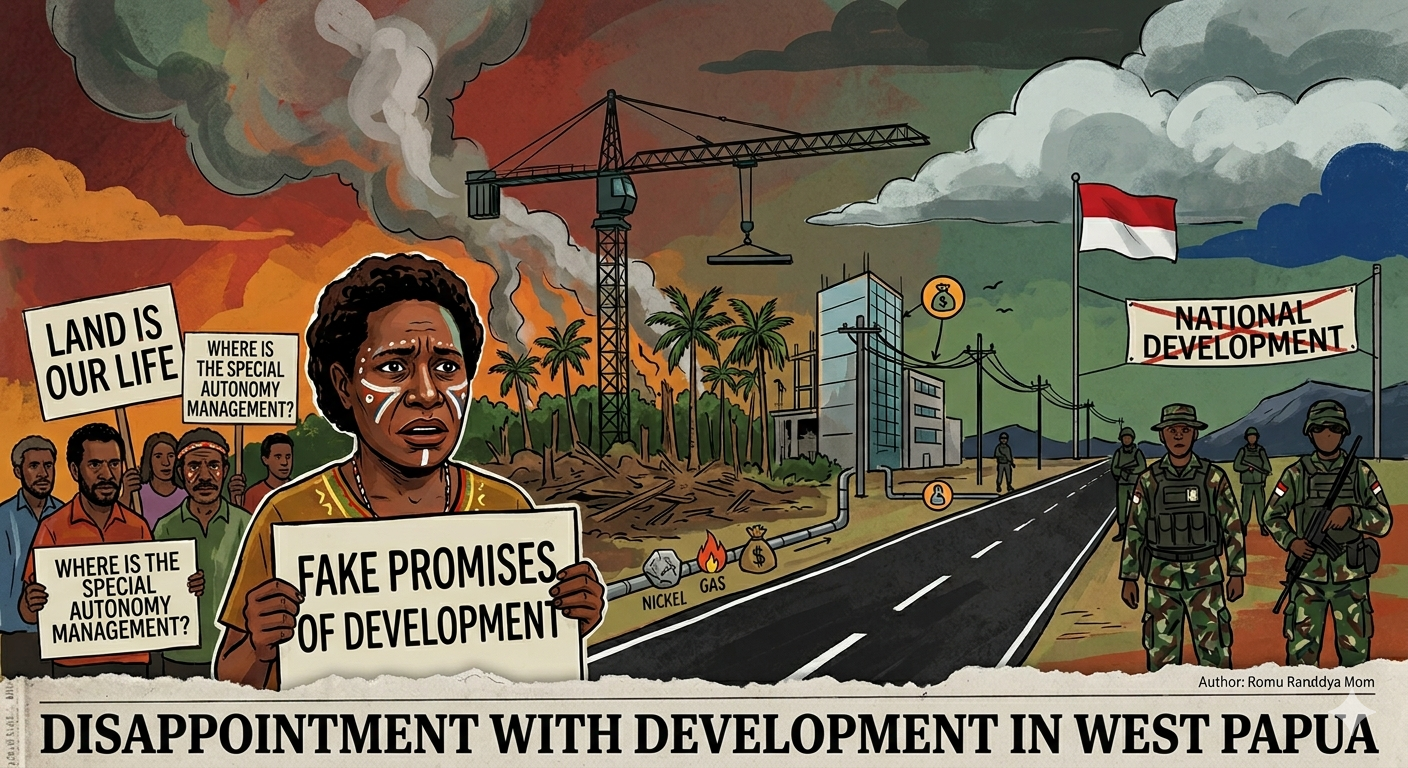
For decades, the story of West Papua has been framed by the central government in Jakarta as one of “accelerated development.” From the massive Trans-Papua Highway to the recent administrative fragmentation into more provinces, the Indonesian state has consistently argued that infrastructure, capital investment, and bureaucratic expansion are the keys to integrating the region and improving the lives of its people. However, as of mid-2026, the sentiment on the ground tells a radically different story. Among indigenous Papuans, there is a profound and growing sense of disappointment—a feeling that “development” is not something being done for them, but rather something being done to them.
The disconnect between Jakarta’s economic statistics and the lived reality of Papuans has created a chasm of trust that now seems wider than ever.
1. The Paradox of “Growth Without Welfare”
The most striking evidence of this disappointment lies in the economic paradox of the region. Despite significant capital injections, development paradigms that prioritize large-scale resource extraction and the expropriation of customary lands (tanah ulayat) have contributed to entrenched structural poverty and intensified social conflict (Surri & Alfianto, 2025). Statistics from early 2026 show that the poverty rate in these provinces remains among the highest in the country.
For indigenous Papuans, these high growth percentages are hollow. The “extractive” nature of the development means that while billions of dollars in resources are shipped out, the wealth rarely trickles down. Furthermore, informal “predatory peace” arrangements in Papua have relied on local elite access to carbon resource rents rather than substantive, inclusive reform (Smith & Williams, 2026). The local sentiment is clear: they are watching their ancestral lands be hollowed out while they remain stuck in a cycle of poverty.
2. The Failure of Special Autonomy (Otsus)
The “Special Autonomy” law (Otsus), first enacted in 2001 and amended in 2021, was intended to protect indigenous rights. However, the 2021 amendments are increasingly viewed as an erosion of Papuan autonomy. Critics argue that these reforms have deepened the centralization of governance, weakened regional bodies, and tightened Jakarta’s control over local political structures and resources (Pamganamamula, 2026).
By 2026, many Papuan leaders view the administrative division of West Papua into new provinces as a tactic to dilute political unity rather than improve service delivery. While the government touts the disbursement of Otsus funds, the accountability mechanisms remain broken, and the Indigenous Representative Bodies (MRP) have seen their powers substantively stripped (Pamganamamula, 2026).
3. Development at the Barrel of a Gun
Perhaps the deepest source of disappointment is the increasing militarization of development. The designation of large agribusiness schemes, such as palm oil plantations, as “National Strategic Projects” (PSN) has led to massive deforestation and human rights violations (Surri & Alfianto, 2025).
In many cases, land acquisition for these projects has occurred without genuine community consent. Between 2022 and 2024, deforestation in Papua accelerated to more than 170,000 hectares, driven primarily by these PSN-aligned concessions (Surri & Alfianto, 2025). The presence of military outposts to “secure” these projects has created an atmosphere of fear, where indigenous communities are often the most affected by violence and intimidation linked to land disputes.
4. The Humanitarian Crisis: The Displaced and the Silenced
The human cost of this friction is staggering. The Papua conflict remains marked by separatist claims and persistent allegations of human rights violations (Amnesty International Indonesia, 2025). As of 2026, many Papuans remain internally displaced due to ongoing security operations.
The government’s response to criticism has often been defensive. Research indicates that regulations like the ITE Law and the Criminal Code are frequently used to limit public criticism and narrow the civic space for human rights advocacy (Bahar et al., 2025). This selective response pattern means that human rights accountability demands are often neither fully rejected nor substantively followed up, leading to a “reactive constitutionalism” where the state only responds when public unrest reaches a crisis level (Journal of National Paradigm-Based Resilience Strategy, 2026).
Conclusion: A Need for Dialogue, Not Just Asphalt
The disappointment of the West Papuan people stems from a fundamental disagreement over what “development” means. To Jakarta, it means roads and GDP growth. To indigenous Papuans, it means dignity, land rights, and the freedom to define their own future.
If the Indonesian government wants to bridge this gap, it must move beyond a “security and infrastructure” approach. It requires a genuine, inclusive dialogue that treats Papuans as partners. Without a humanitarian pause and a return to true autonomy, “development” will continue to be seen as a facade for exploitation.
References
Amnesty International Indonesia. (2025). Amnesty International beberkan 36 video kekerasan polisi di demo Agustus lalu. Journal of National Paradigm-Based Resilience Strategy.
Bahar, A., et al. (2025). Amnesty International Indonesia’s strategy for mainstreaming human rights in the 2024 presidential election campaign. Journal of Indonesian Social and Political Issues, 6(1).
Journal of National Paradigm-Based Resilience Strategy. (2026). Analysis of the demonstration of the Indonesian house of representatives’ allowances in 2025. Journal of National Paradigm-Based Resilience Strategy, 2(1).
Mulyono, H. I., Marlissa, E. R., Titalessy, P. B., & Ratang, S. A. (2025). The impact of government expenditure on improving the quality of human development in Papua Province. Society, 13(2), 1158-1173. https://doi.org/10.33019/society.v13i2.941
Cited by: 1
Pamganamamula, M. (2026). A route to self-determination: Empowering the West Papuan region through targeted Special Autonomy Law reforms and ICCPR/ICESCR. Loyola University Chicago International Law Review, 22(1), 84-110.
Smith, J., & Williams, K. (2026). Does decarbonization undermine carbon-resource reliant peace?: Exploring the resilience of Aceh and Papua’s contrast. White Rose Research Online.
Surri, G., & Alfianto, N. (2025). The pretext of national strategic projects in the palm oil industry: A juridical analysis of massive deforestation and human rights violations in Papua. International Journal of Bakti Olahraga, Sosial, dan Ekonomi, 1(1).
Categories

West Papua View All
This Blog has gone through many obstacles and attacks from violent Free West Papua separatist supporters and ultra nationalist Indonesian since 2007. However, it has remained throughout a time devouring thoughts of how to bring peace to Papua and West Papua provinces of Indonesia.

