The Feast and the Frontier: Inside Pesta Babi and the Battle Over Papua’s Future
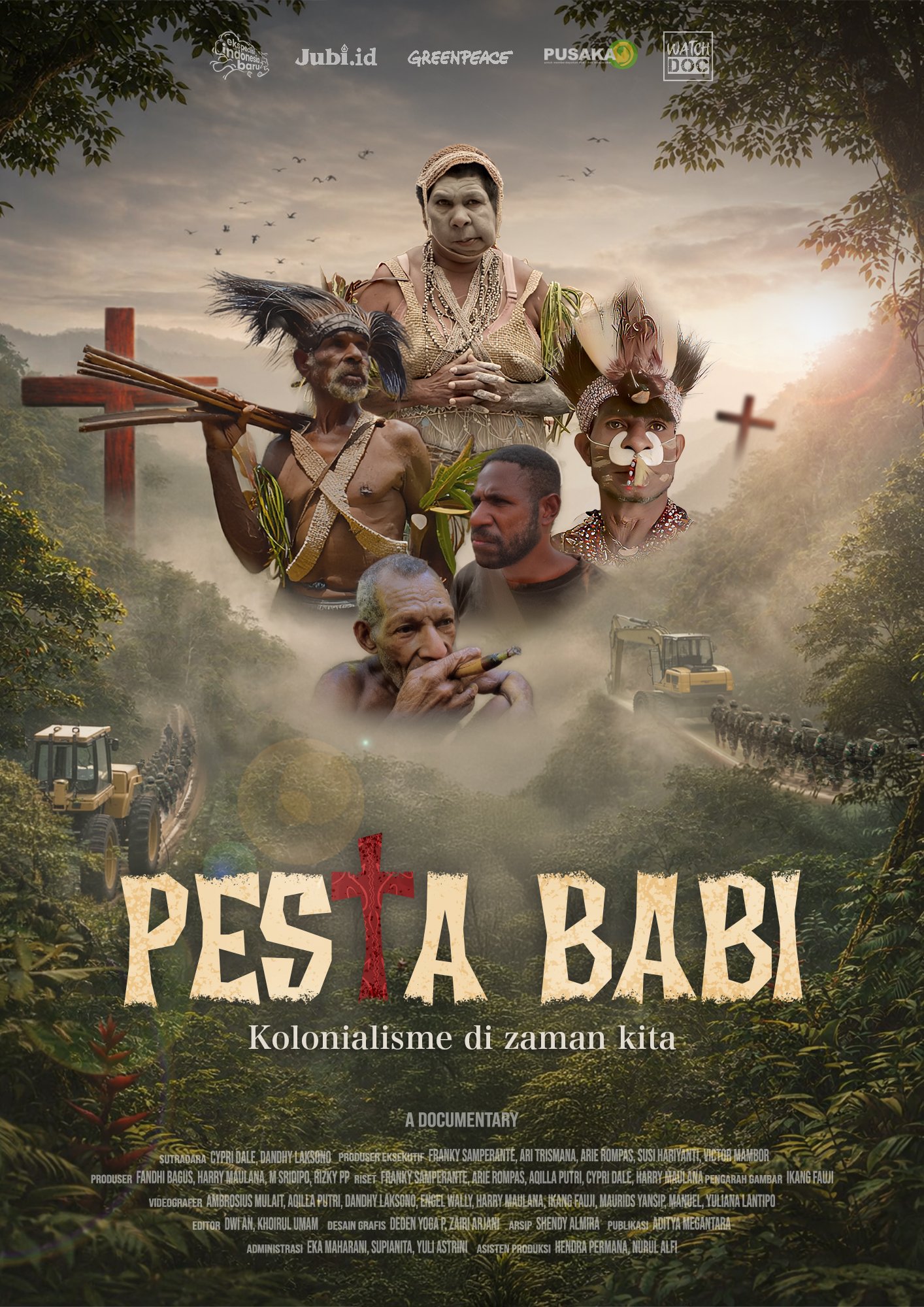
On a humid evening in Yogyakarta, a modest hall filled quietly with students, activists, and a handful of journalists. There was no official banner, no institutional logo, simply just a projector, a white screen, and a shared understanding that what they were about to watch was not merely a film.
When Pesta Babi began, the room fell silent.
What unfolded over the next hour was not a conventional documentary. It did not present itself as neutral, nor did it attempt to smooth over contradictions. Instead, it offered something far more unsettling: a layered portrait of Papua seen through the eyes of those who live closest to the land, people for whom the concept of “development” does not always translate into progress.
By the time the lights came back on, the discussion had already begun, not formally, but in whispers, glances, and the tension that lingers when a narrative challenges something deeply entrenched.
Pesta Babi is not just a film. It is a rupture. It is a challenge. It is a critique. It is a different view.
A Ritual, A Metaphor, A Warning
In Papua, a pig feast is more than a celebration. It is a deeply embedded social institution that binds communities, affirms kinship, and honors ancestral relationships with land. Pigs are not merely livestock; they are currency, status, and history.
The film’s title, Pesta Babi (Pig Feast), draws directly from this cultural foundation. But in the hands of its creators, the ritual becomes a metaphor that hints at a larger, more unsettling question: what happens when a system built on reciprocity and land-based identity collides with a development model driven by extraction, efficiency, and scale?
The answer, as the film suggests, is not harmonious integration, but a very strong and deep friction which is sometimes quiet, sometimes explosive.
Development Without Translation
For decades, Indonesia’s approach to Papua has been anchored in a familiar paradigm: infrastructure, integration, and economic acceleration. Roads, ports, food estates, and industrial expansion are presented as necessary correctives to historical inequality.
From Jakarta’s perspective, this logic is consistent and even compelling. Papua, rich in natural resources yet lagging in key development indicators, is seen as a frontier that must be brought into the national economic system.
But Pesta Babi exposes a fundamental disconnect, what might be called a failure of translation.
Development is being delivered in a language that many Papuans do not speak.
In the film, community members express concerns that are rarely captured in official reports: fear of losing customary land, anxiety over ecological disruption, and a sense that decisions are being made elsewhere, by actors who do not share their lived realities.
This is not merely a critique of policy implementation. It is a critique of the underlying assumption that development is universally understood and universally desired in the same form.
For many indigenous Papuans, land is not a commodity. It is a living archive of ancestry, identity, and survival. When land is transformed into an economic asset, something else is lost, something less visible but no less consequential.
The Political Economy of Expansion
The tensions depicted in Pesta Babi cannot be separated from the broader political economy of Papua.
Large-scale projects whether food estates, mining operations, or infrastructure corridors are not isolated initiatives. They are part of a strategic vision to integrate Papua more deeply into national and global economic networks.
Yet this integration often follows a familiar pattern seen in other frontier regions around the world: capital arrives faster than governance, and extraction moves ahead of consent.
Critics argue that such models risk reproducing what some scholars describe as “internal colonial dynamics,” where peripheral regions are developed primarily to serve national or external interests, rather than local needs.
The Indonesian government, for its part, frames these initiatives as necessary interventions to address poverty, food security, and regional disparity. From a macroeconomic standpoint, the argument holds weight.
But Pesta Babi forces a different lens that centers the question of agency.
Who decides what development looks like?
And who bears its costs?
A Film That Traveled Beyond the Screen
Unlike mainstream releases, Pesta Babi did not rely on commercial distribution channels. Instead, it spread through networks like campuses, civil society groups, diaspora communities, and informal collectives.
Screenings were held in cities such as Yogyakarta, Ternate, Papua, Aceh, West Nusa Tenggara and elsewhere, often accompanied by discussions that extended long after the film ended. In some cases, these gatherings were small and discreet. In others, they attracted wider attention and, occasionally, intervention. It may reach hundreds locations in the near future.
Reports of disrupted screenings and heightened scrutiny only amplified the film’s visibility. In the digital age, attempts to contain a narrative often have the opposite effect: they make it travel faster.
Internationally, the film found audiences in places like Sydney and New Zealand, where diaspora communities and academic circles engaged with its themes. These screenings transformed the film from a national controversy into a transnational conversation.
What emerged was not a unified interpretation, but a shared recognition that the issues it raised could not be easily dismissed.
The Digital Amplification of Dissent
One of the most striking aspects of Pesta Babi’s impact lies in its afterlife online.
Clips, quotes, and discussions circulated widely across social media platforms, reaching audiences far beyond those who attended physical screenings. In this sense, the film became part of a broader ecosystem of digital discourse that is increasingly difficult for states to control.
This shift is significant.
In the past, narratives about Papua were often mediated through official channels or limited journalistic access. Today, digital platforms allow alternative perspectives to emerge and spread with unprecedented speed.
However, this also introduces new complexities. The same digital space that enables critical discourse can also amplify polarization, misinformation, and competing narratives.
In this environment, Pesta Babi functions not just as a documentary, but as a node within a larger contest over meaning.
Security, Stability, and the Limits of Control
For the Indonesian state, Papua is not only a development challenge but also a security concern. Issues of separatism, armed groups, and territorial integrity remain deeply sensitive.
This dual framing on Papua as both an economic frontier and a security priority creates a tension that is visible in how narratives are managed.
From a security perspective, controlling information can be seen as a means of maintaining stability. But from a democratic perspective, restricting discourse risks eroding trust.
Pesta Babi sits precisely at this intersection.
It raises questions that are uncomfortable for policymakers: whether stability achieved through control is sustainable, and whether long-term security can be built without addressing underlying grievances.
A Crisis of Trust
Perhaps the most important insight offered by Pesta Babi is not about any single project or policy, but about a deeper structural issue: a growing gap in trust.
For many Papuans, there is a perception that development is something done to them, rather than with them. For the state, there is frustration that progress is often met with resistance.
This mutual skepticism creates a feedback loop. Each side interprets the other’s actions through a lens of suspicion, making genuine dialogue increasingly difficult.
In such a context, even well-intentioned policies can fail. It is not because they are inherently flawed, but because they lack legitimacy in the eyes of those most affected.
Beyond the Binary
It would be easy to frame Pesta Babi as simply “pro” or “anti” government, as advocacy or as critique. But such binary interpretations miss the film’s deeper significance.
At its core, the film is about visibility.
It brings into view experiences, voices, and perspectives that are often marginalized in national conversations. It does not claim to offer a complete picture, but it insists that certain realities must be acknowledged.
For policymakers, this presents both a challenge and an opportunity.
The challenge is to engage with criticism that is not always comfortable. The opportunity is to rethink how development, security, and inclusion are approached in Papua.
The Unresolved Questions
As the discussions following Pesta Babi continue, several questions remain unresolved:
- Can development be reimagined in a way that genuinely incorporates indigenous knowledge and consent?
- How can the state balance its legitimate security concerns with the need for open dialogue?
- What mechanisms can bridge the gap between national policy frameworks and local realities?
- And perhaps most fundamentally: what does it mean to belong, to be heard, and to have agency in shaping one’s future?
These are not questions that a film can answer.
But they are questions that a film can force us to confront.
Conclusion: The Feast Continues
In Papua, a pig feast is never just an event. It is a process of preparation, participation, and reflection. It brings people together, but it also reveals underlying dynamics within a community.
Pesta Babi, in its own way, performs a similar function.
It gathers stories, amplifies tensions, and invites participation in a conversation that is far from over.
For Indonesia, the stakes of that conversation are high. Papua is not just a region to be developed or secured; it is a space where the meaning of nationhood, justice, and belonging is being actively negotiated.
The question is not whether that negotiation will happen.
It already is.
The question is whether it will be inclusive, or imposed.
And like any feast, the outcome will depend not only on what is served, but on who is invited to the table.
The man behind Pesta Babi

Dandhy Laksono is an Indonesian investigative journalist and documentary filmmaker widely recognized for his critical, field-based storytelling on social, environmental, and political issues. As a co-founder of Watchdoc Documentary, he has built a reputation for producing films that challenge official narratives and bring marginalized perspectives, particularly from resource-rich but conflict-prone regions like Papua into national and international discourse. Through Pesta Babi, Laksono continues this approach, positioning the film not merely as a documentary, but as a provocative intervention that questions dominant models of development, highlights indigenous experiences, and stimulates public debate on state policy, accountability, and justice.
westpapua.online
Categories
Activists, Culture, Development, Environment, West Papua Development

West Papua View All
This Blog has gone through many obstacles and attacks from violent Free West Papua separatist supporters and ultra nationalist Indonesian since 2007. However, it has remained throughout a time devouring thoughts of how to bring peace to Papua and West Papua provinces of Indonesia.

