Domination Without Violence: Deception and the Architecture of Control in West Papua
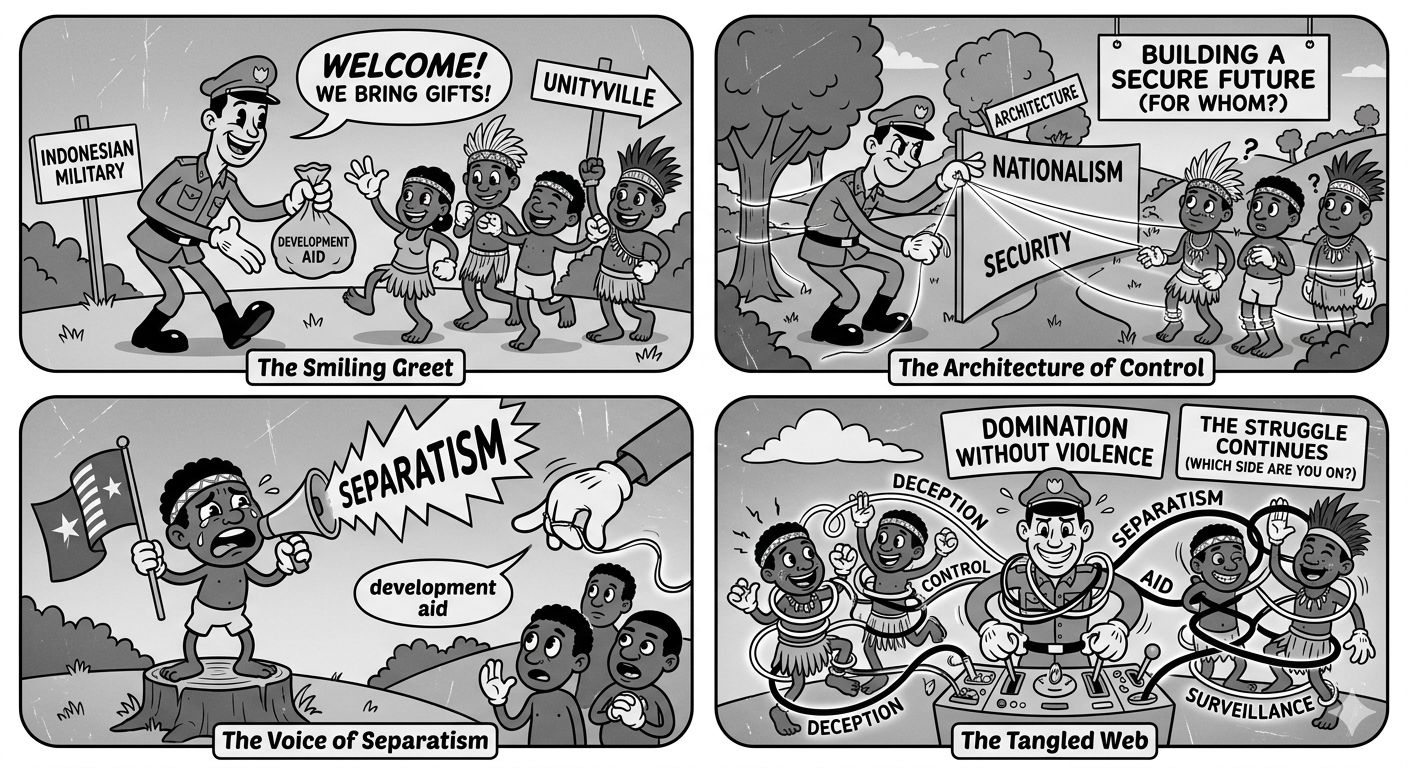
The concept of “domination without violence” refers to a sophisticated exercise of power where control is maintained not through visible, kinetic force, but through the strategic use of structural, economic, and discursive deception. In West Papua, this has evolved into a bidirectional war of narratives, where both the Indonesian government and separatist movements attempt to “stifle through embrace” or “legitimize through victimhood” to dismantle the opposing agency without the immediate optics of military combat.
I. The Indonesian Government: The Developmentalist Mirage
The most potent tool of non-violent state domination is “developmentalism,” where massive state intervention is framed as a benevolent response to poverty to justify the transformation of indigenous landscapes.
- The PSN as a Legal Shield: National Strategic Projects (PSN) serve as a primary method of control by providing a legal “fast-track” that bypasses environmental protections and indigenous land rights.
- Economic Erasure through “Connectivity”: The Trans-Papua Highway is marketed as a tool for “prosperity,” yet its primary function is often seen as facilitating the entry of migrant-dominated commerce and military logistics into previously inaccessible highland territories.
- The Bureaucratic Scalpel: The creation of New Autonomous Regions (DOB) is presented as “bringing services closer to the people,” but critics argue it is a strategic move to dilute Papuan political unity and co-opt local elites into the Jakarta-led administrative structure.
- Deceptive Humanitarianism: Jakarta increasingly employs a “humanitarian shield,” promoting quick-win programs like free healthcare or scholarships to seek international legitimacy while restricting access to internally displaced persons (IDPs) in conflict zones.
II. The Separatist Movement: Narrative Sovereignty and Information Warfare
Conversely, the separatist movement—both the armed wing (TPNPB) and its diplomatic counterparts—pursues its own form of “domination without violence” through the internationalization of the Papuan identity and the weaponization of the “victimhood narrative.”
- The Branding of Resistance: Pro-independence hardliners often utilize digital platforms to frame every state action, including genuine healthcare or education initiatives, as “colonial deception” or “slow-motion genocide”. This binary labeling aims to dominate the Papuan mind, making any cooperation with the state appear as a betrayal.
- Diplomatic Encirclement: By focusing heavily on international forums and Pacific island nations, the movement attempts to dominate the external narrative of the conflict, pressuring Jakarta through global public opinion rather than military victory.
- Sycophancy vs. Loyalty: A key method of internal control within the separatist movement is the labeling of Papuans who work within the legal framework as “sycophants” or “government puppets,” effectively narrowing the civic space for any “Third Path” or moderate indigenous advocacy.
III. The Trap of the Binary: Structural Deception on Both Sides
Both the ultranationalist state and the separatist movement utilize “Gray-zone” tactics to silence the middle ground, creating a reality where indigenous Papuans are caught between two competing forms of domination.
- The Case of IDPs: While the state denies the extent of the humanitarian crisis in the highlands to avoid international scrutiny, some separatist narratives may leverage the suffering of displaced persons primarily as a political tool for independence, rather than prioritizing immediate, neutral humanitarian relief.
- Resource Capture and Indigenous Veto: The state’s focus on “downstreaming” industries—such as nickel for EV batteries—presents a modern, “green” image to the world, yet it effectively steals the “capital of the future” from indigenous generations. Simultaneously, hardline separatist stances can sometimes block local development projects that communities actually desire, using the “independence first” mandate to override local tribal consensus.
Conclusion: The Silent Occupation of the Mind
In West Papua, domination without violence is a war for the “hearts and minds” fought with bureaucracy, hashtags, and infrastructure. By framing ecocide as development and fragmentation as empowerment, the Indonesian state attempts to normalize dispossession. Meanwhile, by framing every negotiation as a betrayal, the separatist movement risks trapping the indigenous people in a perpetual state of conflict that prevents the realization of immediate rights. The “Third Path” requires rejecting both deceptions—the violence of the rebel and the oppression of the state—to focus on the inherent dignity of the indigenous Papuan to live in safety and cultural integrity.
References
- Westpapua.online Editorial (2026). The Hollow Promise of Development.
- Pamganamamula, M. (2026). The Re-centralization of Power: A Critique of the 2021 Special Autonomy Amendments.
- Amnesty International Indonesia (2025). Annual Report on Human Rights in Papua.
- Westpapua.online Editorial (2026). The Third Path for West Papua: Transcending the Binary of Ultranationalism and Separatism.
- Smith, J., & Williams, K. (2026). Extractive Peace: The Fragility of Resource-Based Stability.
- Mulyono, H. I., et al. (2025). Growth Without Welfare: The HDI Paradox in Papua.
- Surri, G., & Alfianto, N. (2025). The Pretext of National Strategic Projects: A Juridical Analysis.
Categories

West Papua View All
This Blog has gone through many obstacles and attacks from violent Free West Papua separatist supporters and ultra nationalist Indonesian since 2007. However, it has remained throughout a time devouring thoughts of how to bring peace to Papua and West Papua provinces of Indonesia.
 WEST PAPUA