The Cartography of Extraction: A Critical Analysis of Resource Imperialism and Capitalist Accumulation
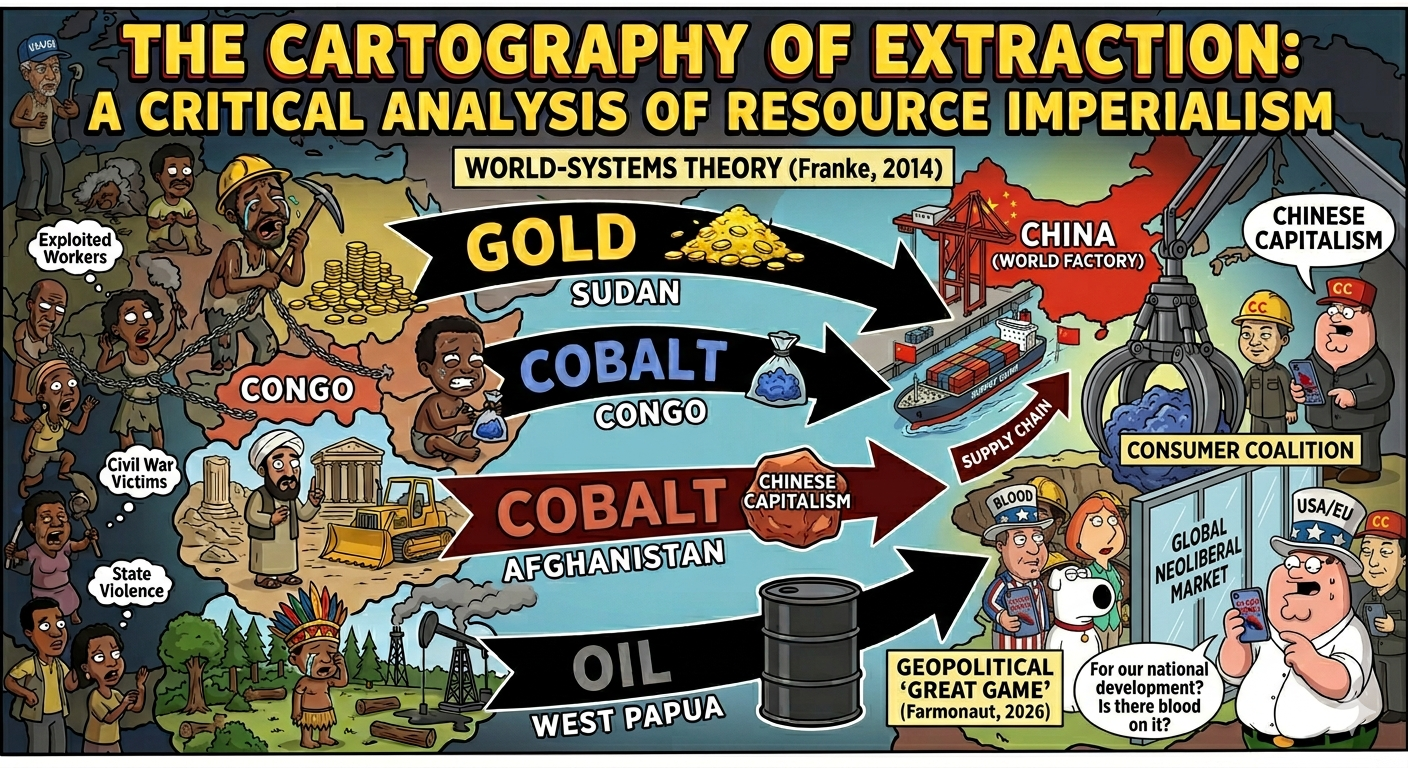
The geopolitical landscape of the 21st century reveals a disturbing correlation: the presence of high-value natural resources frequently coincides with systemic violence, state fragility, and what scholars increasingly term “cold genocide.” From the gold mines of Sudan and the cobalt pits of the Democratic Republic of Congo (DRC) to the copper deposits in Afghanistan and the oil-rich rainforests of West Papua, the “western imperial machine” of consumer capitalism appears to thrive on the instability of the periphery. By applying World-Systems Theory, Disaster Capitalism, and the Genocide-Ecocide Nexus, this analysis argues that the suffering in these nations is not an accidental byproduct of internal failure, but a structural requirement for the continuous accumulation of global capital.
I. Theoretical Framework: The Core-Periphery Hierarchy
To understand why “attractive” resources lead to “intense suffering,” one must first utilize World-Systems Theory, which posits that the global economy is divided into a dominant, wealthy “core” and a subservient, impoverished “periphery” (Franke, 2014). In this zero-sum game, the economic development and high consumption standards of the core (the West) are achieved at the direct expense of environmental and social destruction in the periphery (Franke, 2014; Hout, 2016).
This relationship is sustained through Dependency Theory, where peripheral nations are integrated into the world market solely as providers of raw materials. This integration enhances inequality rather than alleviating it, as the “market value” of the resource is extracted while the “social cost” (violence, displacement, pollution) remains internalized within the local population (Hout, 2016).
II. Case Studies: The Commodities of Conflict
Sudan: Gold and the Marketplace of Instability
In Sudan, the transition from an oil-based economy to a gold-based one after the 2011 secession of South Sudan illustrates how resources fuel political “marketplaces” (Booms, 2024). Gold, being more easily extractable and transportable than oil, empowered paramilitary actors like the Rapid Support Forces (RSF), shifting power away from traditional state structures toward warlords who can bypass formal international regulations. Using the lens of Disaster Capitalism, we see that instability itself acts as a form of “currency” (Kenny, 2025).
The Congo: The “Green” Paradox of Cobalt
The DRC provides approximately 70% of the world’s cobalt, a mineral essential for the lithium-ion batteries powering the global transition to “green” energy (Wootton, 2026). This creates Cobalt’s Climate Paradox: the global North’s efforts to mitigate climate change through electrification rely on “blood-stained hands” in the South. The exploitation is characterized by modern-day slavery and ecological devastation, where local communities are viewed as “primitive obstacles” to be managed or displaced in the pursuit of resource security (Karimah, 2025).
Afghanistan: Copper and the “Great Game”
Afghanistan defines the modern “imperial machine” through its $1 trillion in untapped mineral wealth, particularly the Mes Aynak copper deposit—one of the largest in the world (Farmonaut, 2026). In 2026, Afghanistan serves as a primary example of Uneven and Combined Development (UCD). While global actors press for hyper-modern industrial extraction, the local population remains in a state of “archaic survival” (ResearchGate, 2026). From a Political Ecology standpoint, the Buddhist ruins and indigenous history of Mes Aynak are treated as mere cost-inefficiencies, slated for excavation to fuel the batteries of the global North (Ariana News, 2026).
West Papua: Oil and “Cold Genocide”
In West Papua, the extraction of crude oil and the expansion of massive food and energy estates represent a form of frontier-making, where indigenous lands are reimagined as empty spaces for capital expansion (Yuwono, 2026). This is often analyzed as a “cold genocide”—a gradual destruction of a group’s identity and physical security through systemic oppression and the Genocide-Ecocide Nexus, where the destruction of the environment essential to survival is a functional means to an end for extractive capitalism (Short & Crook, 2022).
III. Comparative Analysis: The Imperial Machine
| Resource | Nation | Primary Mechanism of Suffering | Theoretical Lens |
| Gold | Sudan | Conflict as a marketplace; paramilitary empowerment. | Disaster Capitalism |
| Cobalt | Congo | Modern slavery justified by “green” transitions. | Political Ecology |
| Copper | Afghanistan | Geopolitical “Great Game” for mineral security. | Uneven Development |
| Oil | West Papua | Dispossession and cultural erasure. | Genocide-Ecocide Nexus |
In each case, the neoliberal order is complicit in “structural violence” (Williams, 2026). The western consumer machine requires these minerals to be cheap and abundant. To keep them cheap, the labor and land must be devalued. This devaluation is most effectively achieved through conflict, which prevents the emergence of strong, sovereign states that might nationalize resources or enforce strict labor laws.
IV. Conclusion
The “intense suffering” described in these nations is not a failure of capitalism, but its logical conclusion when applied to the Global South. By framing resource-rich areas as “unstable,” the imperial machine justifies interventions that ultimately secure the flow of commodities to the core. A critical analysis reveals that as long as the global economy operates on a model of endless accumulation and unequal exchange, the resources of the periphery will continue to be a death sentence for the people living above them.
References
- Anderson, K. (2015). Colonialism and Cold Genocide: The Case of West Papua. Genocide Studies and Prevention, 9(2), 9–25.
- Ariana News. (2026). Ministry of Mines Updates on Mes Aynak Extraction Timeline.
- Booms, S. (2024). Oil, Gold, and Guns: The Violent Politics of Sudan’s Resource Booms. World Peace Foundation.
- Farmonaut. (2026). The $1 Trillion Potential: Afghanistan’s Mineral Wealth and Global Security.
- Franke, M. (2014). Social, Ecological and Economic Dimensions of Extraction. EconStor.
- Hout, W. (2016). Capitalism and the Third World. Erasmus University Rotterdam.
- Karimah, H. (2025). Political Ecology in Cobalt Mining in the DRC. Indonesian Journal of International Relations.
- Kenny, F. (2025). Profiting From Instability: Disaster Capitalism in Sudan. Critical Debates in Global Justice.
- Lowy Institute. (2026). Resource Surrender: The Geopolitics of Afghan Copper.
- Short, D., & Crook, M. (2022). The Genocide-Ecocide Nexus. Routledge.
- Williams, R. (2026). The Genocide-Ecocide Nexus: A Review. Holocaust and Genocide Studies.
- Wootton, A. (2026). Cobalt’s Climate Paradox: Blood-Stained Hands. Natural Resources Journal.
- Yuwono, F. P. (2026). Legal Implications of the Merauke Food Estate. Lex Publica.
Categories

West Papua View All
This Blog has gone through many obstacles and attacks from violent Free West Papua separatist supporters and ultra nationalist Indonesian since 2007. However, it has remained throughout a time devouring thoughts of how to bring peace to Papua and West Papua provinces of Indonesia.

