The Cowardice of the Censors vs. The Triumph of Truth: Why Yusril and Pigai Just Saved Indonesian Democracy
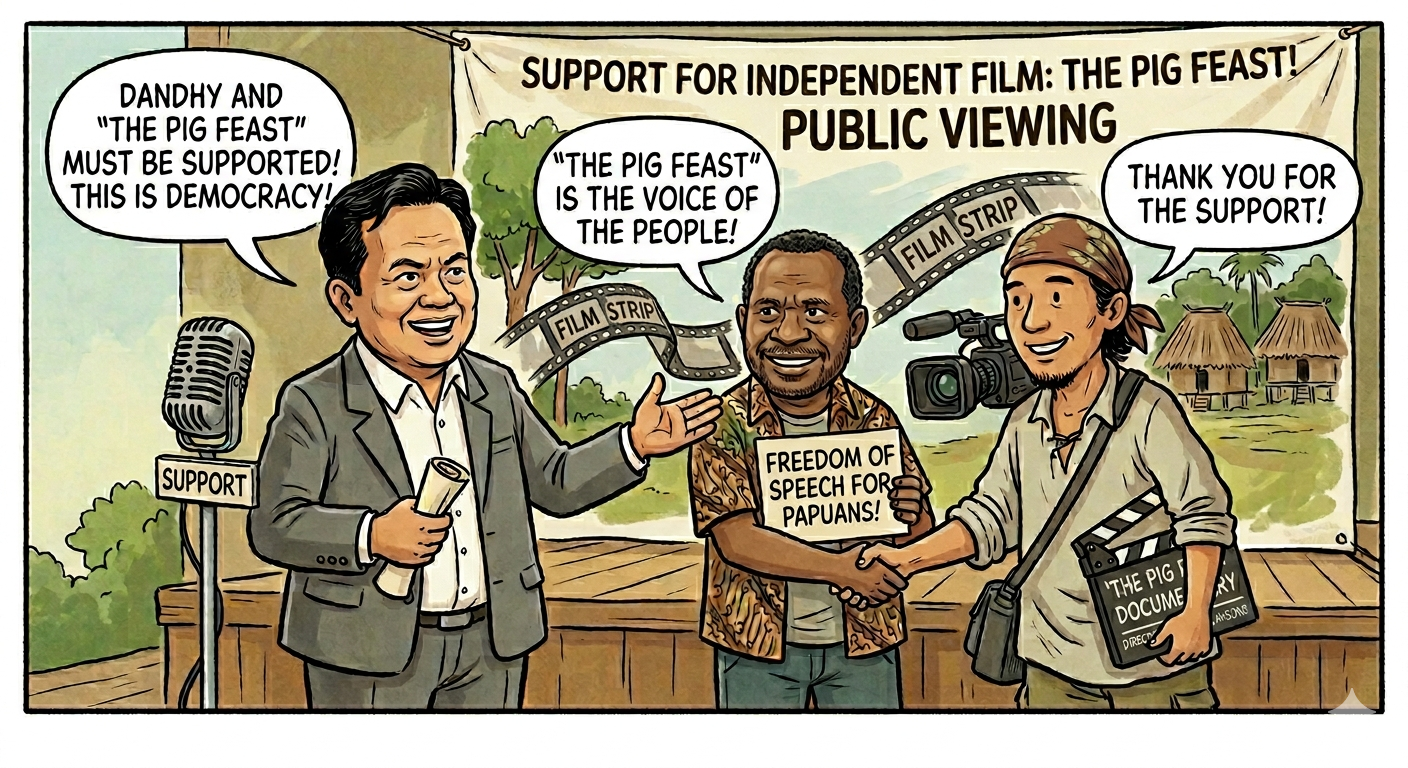
Indonesia is currently witnessing a pathetic, desperate display of local authoritarianism. Across various regions, small-minded campus bureaucrats and overzealous local security apparatuses have thrown a collective temper tantrum over a movie screen. The weapon of their cowardice? The aggressive, unlawful shutdown of public screenings (nonton bareng or nobar) of the explosive documentary, Pesta Babi: Kolonialisme di Zaman Kita (The Pig Feast: Colonialism in Our Time).
At Universitas Mataram (Unram), UIN Mataram, and via aggressive local military intimidation in Ternate, we watched in real-time as local authorities cringed at the sight of a projector. Terrified of a film that exposes the structural rot, environmental degradation, and violations of indigenous land rights under the guise of National Strategic Projects (PSN) in Southern Papua, these local tyrants tried to do what authoritarians always do: pull the plug, hide behind arbitrary “administrative procedures,” and force-feed the public a diet of absolute silence.
But their attempts to suffocate free thought just hit a steel wall at the highest levels of state. In a political landscape where we are conditioned to expect official pushback against dissent, the unwavering stances of Coordinating Minister for Law, Human Rights, Immigration, and Correctional Affairs Yusril Ihza Mahendra and Human Rights Minister Natalius Pigai are nothing short of a spectacular victory for Indonesian democracy. They did not just issue tepid, non-committal bureaucratic answers; they utterly humiliated the local censors on the national stage.
Anatomy of Local Cowardice: The Paranoia of the Projector
To understand the magnitude of what Yusril and Pigai achieved, one must look at the sheer absurdity of the forces arrayed against the film. Pesta Babi, directed by investigative journalists Dandhy Dwi Laksono and Cypri Paju Dale under the Ekspedisi Indonesia Baru banner, is an unsparing look at the Merauke Integrated Food and Energy Estate (MIFEE) and subsequent mega-agricultural projects in Southern Papua. The title itself draws from the traditional pesta babi (pig feast), a sacred, foundational ritual of social cohesion, alliance-building, and conflict resolution among indigenous Papuan communities. The documentary illustrates a painful irony: while indigenous communities utilize the pig feast to maintain cosmic and communal balance, the corporate-state apparatus is throwing its own “feast” of exploitation, carving up ancestral forests into corporate sugarcane and rice estates without meaningful consensus.
For local university rectors, campus security guards, and local military units, this narrative was deemed “too dangerous.” At Universitas Mataram, campus authorities forcefully disrupted a student-led screening, claiming it “discredited the government” and threatened the stability of the academic environment. In Ternate, North Maluku, the Alliance of Independent Journalists (AJI) faced direct intimidation when local military (TNI) personnel moved to shut down a screening, citing a lack of local permits.
This is a classic manifestation of what political scientists call “peripheral authoritarianism” where localized actors, desperate to signal loyalty to the central government, become more royalist than the king. They pre-emptively suppress dissent, operating under the outdated assumption that Jakarta wants all criticism buried. They assume that the state is fragile, that the public is gullible, and that the best way to protect a government policy is to pretend its consequences do not exist.
A Masterclass in Democratic Sanity: Yusril Ihza Mahendra’s Decisive Rebukes
Yusril Ihza Mahendra did what weak-kneed university rectors and local commanders failed to do: he showed intellectual and constitutional backbone. By explicitly stating that the central government has absolutely never issued a directive, decree, or law banning Pesta Babi, Yusril stripped the local censors of their favorite ideological shield. They could no longer pretend they were acting on behalf of state security or national interests.
Yusril dismissed their manufactured panic with cold, democratic reality. He pointed out that the film had already been screened without incident in various major cities across Java, including Bandung and Sukabumi, proving that public order does not collapse when citizens watch a documentary.
More importantly, Yusril reframed how the state should view provocative art. He did not blink at the film’s fierce critique of the government’s National Strategic Projects. Instead, he welcomed it as a normal, healthy exercise of public criticism. In a democracy, a government policy is not a holy scripture immune to scrutiny; it is a hypothesis that must be tested against its real-world impacts. By declaring that public critique is essential for state evaluation, Yusril reminded the country that a confident state does not hide behind censorship, it engages in the arena of public discourse.
Stripping Censors of Their Fake Authority: Natalius Pigai’s Constitutional Hammer
If Yusril provided the administrative and political clarity, Human Rights Minister Natalius Pigai brought the constitutional hammer. As a prominent human rights defender from Papua himself, Pigai understood exactly what was at stake: the systematic erasure of Papuan voices and the illegal restriction of civic space.
Pigai openly rebuked the local military and campus actors who took it upon themselves to act as thought-police. He laid down a fundamental constitutional truth that every local official needs to internalize: you do not possess the arbitrary authority to ban creative expression. Pigai reminded the nation that under Indonesian law, a creative, cinematic, or journalistic work can only be legally suppressed or prohibited from public view through a formal, transparent court ruling or explicit legislation. It cannot be banned by the whim of an insecure campus security chief, an overzealous rector, or a local military officer worried about “provocation”.
Pigai’s message to the critics of Pesta Babi was beautifully brutal: if you do not like the narrative presented in the documentary, do not pick up a pair of scissors or call the police. Pick up a camera. Write a counter-argument. Produce your own documentary defending the National Strategic Projects. This is the very essence of freedom of speech, countering speech you dislike with more speech, not with state-sponsored violence or administrative sabotage. By fiercely defending the public’s right to witness and critique the Papuan struggle, Pigai vindicated every student, journalist, and activist who refused to let the screens go dark.
The Irony of the Lens: The Streisand Effect in Full Force
The absolute irony of this entire saga is that the local shutdowns achieved the exact opposite of what the censors intended. This is the Streisand Effect operating at its finest. By dragging the projectors into the dark, local authorities only shone a massive, undeniable, multi-million-watt spotlight on Pesta Babi.
Had the university rectors in Mataram or the military personnel in Ternate allowed the screenings to proceed quietly, the film would have been viewed by a few hundred students and local activists. It would have sparked an intense but localized intellectual debate. Instead, by using heavy-handed tactics, intimidation, and bureaucratic threats, the censors turned a regional documentary screening into a national cause célèbre. They transformed Pesta Babi from a film about Papuan land rights into a litmus test for the survival of Indonesian democracy itself.
To the local authorities who claimed Pesta Babi was “too dangerous” for students: your fragility is embarrassing. When an academic institution suggests that students should avoid a documentary because it might cause “restlessness,” they are confessing their own intellectual bankruptcy. A university is supposed to be a sanctuary for uncomfortable truths, a place where ideas are cross-examined, and where students learn to think critically about the world around them. When a university becomes an active agent of censorship, it ceases to be an institution of higher learning and degenerates into an expensive compliance mill.
Conclusion: The Screens Stay Up
The narrative war over West Papua and state development is far from over. The tension between state-led nationalism and local indigenous sovereignty remains one of the most complex, painful challenges facing modern Indonesia. But what Yusril Ihza Mahendra and Natalius Pigai have fiercely defended is the right of the Indonesian public to participate in that conversation. They have drawn a definitive line in the sand against the creeping tide of local authoritarianism.
They have reminded the nation that Indonesia is not a fragile, glass-republic that will shatter at the sight of an independent camera lens. It is a vast, mature, and resilient democracy capable of confronting its own flaws, listening to its marginalized citizens, and tolerating fierce dissent.
The central government has spoken with absolute clarity: The screens stay up. The debate goes on. Let the public watch Pesta Babi, let the arguments rage across campuses, coffee shops, and public squares, and let the local censors sit in the self-inflicted darkness where they belong.
References
- Boelaars, D. R. J. (1986). Manusia Irian: Orang Asmat, Orang Dani, Orang Mandobo, Orang Marind, Orang Muyu. Stichting Papua Erfgoed.
- Siagian, R. C. (2025). TNI bubarkan nobar film ‘Pesta Babi’ di Ternate, AJI kecam adanya intimidasi. Tandaseru.
C

West Papua View All
This Blog has gone through many obstacles and attacks from violent Free West Papua separatist supporters and ultra nationalist Indonesian since 2007. However, it has remained throughout a time devouring thoughts of how to bring peace to Papua and West Papua provinces of Indonesia.

