The Hollow Promise of Development: Why Jakarta is Losing the Battle for Papuan Hearts and Minds
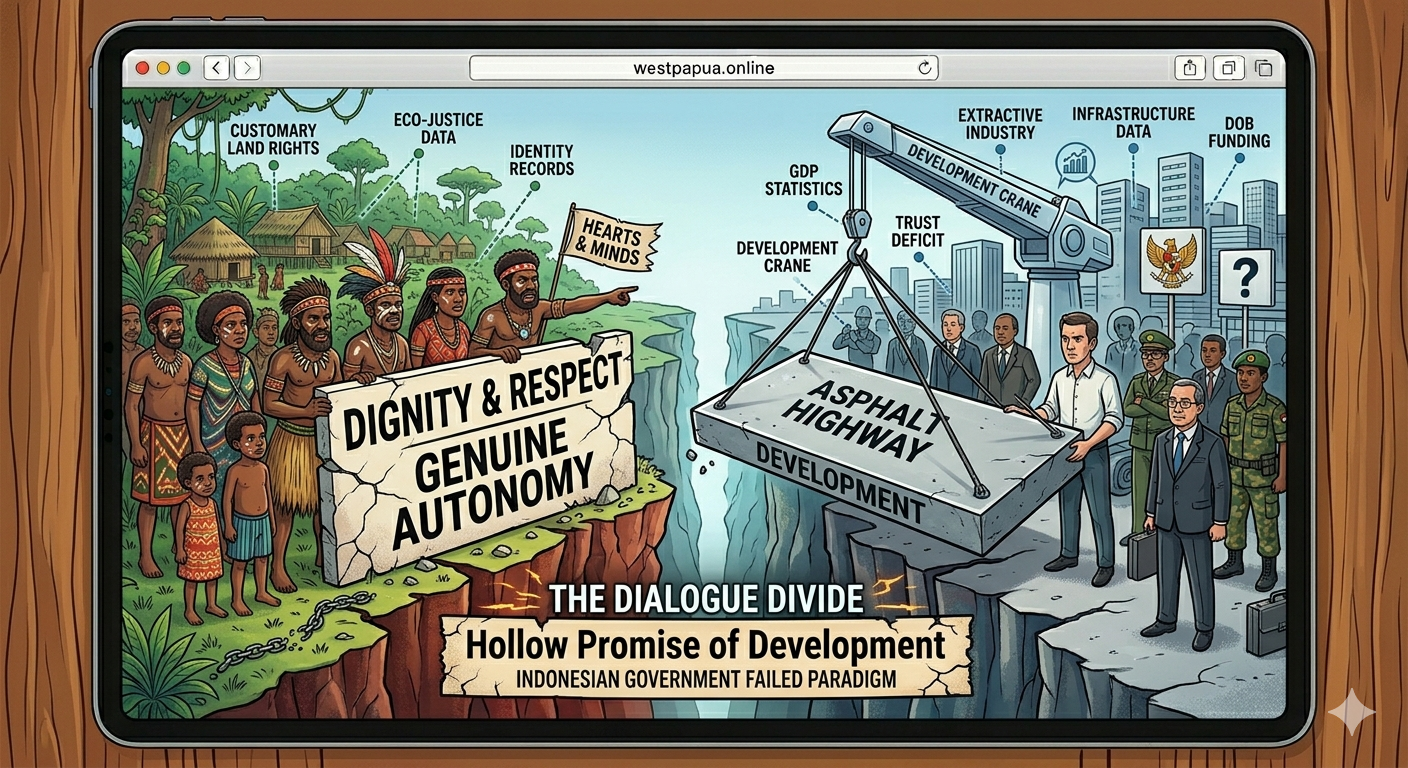
By westpapua.online Editorial Staff
For over half a century, the high-altitude forests and coastal mangroves of West Papua have been the stage for one of the world’s most protracted and misunderstood socio-political struggles. To the central government in Jakarta, Papua is a “National Strategic Area”—a frontier of untapped economic potential and a testbed for state-led modernization. To the indigenous Papuans (Orang Asli Papua or OAP), however, it is a homeland where “development” often feels like a euphemism for displacement.
As we move through 2026, the Indonesian government remains trapped in a developmentalist echo chamber. Despite injecting hundreds of trillions of Rupiah into the region, the “trust deficit” has not narrowed; it has cratered. Jakarta’s persistent failure to win the “hearts and minds” of Papuans is not a matter of insufficient funding, but a fundamental failure of political imagination and human empathy.
I. The Infrastructure Fetish: Asphalt vs. Ancestry
The centerpiece of President Joko Widodo’s legacy—and one continued by his successors—is the Trans-Papua Highway. This 4,000-kilometer ribbon of asphalt is touted as the “vein of Papuan prosperity.” Yet, for many OAP, the road is a double-edged sword.
The Migrant Monopoly
Critics argue that infrastructure in Papua primarily serves as a conduit for a “migrant-driven economy.” When a road reaches a remote highland village, it is rarely the indigenous farmer who thrives. Instead, it is the savvy migrant trader from Sulawesi or Java who possesses the capital and supply-chain networks to dominate the new local market. The indigenous population finds itself relegated to the margins of their own economy—watching trucks carry away resources while they struggle to afford basic goods inflated by the very “connectivity” promised to help them.
The Extractive Trap
Jakarta’s economic success stories in Papua are almost exclusively extractive. The Tangguh LNG project and the Grasberg mine generate astronomical GDP figures that look excellent on a spreadsheet in Jakarta. However, West Papua remains home to the highest poverty rates in the archipelago, hovering near 20% in early 2026. This “Growth Without Welfare” is a sharp critique of a system that prioritizes corporate concessions over community-led cooperatives.
II. The Illusion of Autonomy: From “Special” to “Superficial”
The Law on Special Autonomy (Otsus), enacted in 2001, was meant to be the “Middle Way”—a compromise to quell independence calls by granting Papuans the right to manage their own house. Twenty-five years later, that house is being managed from an office in Jakarta.
The 2021 Betrayal
The unilateral amendment of the Otsus Law in 2021 marked a turning point in Papuan disappointment. By stripping the Papuan People’s Assembly (MRP) of its power to approve or reject key policies, Jakarta effectively hollowed out the “Special” in Special Autonomy. The subsequent fragmentation of Papua into six provinces (DOB) was executed with clinical speed and a total lack of meaningful consultation.
Divide and Rule
The government’s argument for these new provinces was “bureaucratic efficiency.” The reality, as viewed by Papuan intellectuals, was a “Divide and Rule” tactic. By carving the territory into smaller administrative units, Jakarta has successfully diluted Papuan political unity, created thousands of new civil service jobs to co-opt local elites, and justified a massive expansion of the military and police presence in newly created provincial capitals. This is not governance; it is administrative engineering designed to secure control, not to empower people.
III. The Militarization of “Public Services”
Perhaps the sharpest critique of the Indonesian state is its inability to decouple “development” from “security.” In West Papua, the soldier and the surveyor often arrive in the same vehicle.
The Security Approach
The designation of projects like the Merauke Integrated Rice Estate as “National Strategic Projects” (PSN) allows the state to bypass environmental regulations and indigenous land rights under the guise of “national urgency.” In 2025 and 2026, reports have surfaced of the TNI (Indonesian National Armed Forces) being directly involved in clearing land for agribusiness. When an indigenous tribe loses its hunting grounds to a corporate plantation guarded by soldiers, they do not see “progress”—they see an occupying force.
The IDP Crisis: A Silent Tragedy
While Jakarta promotes images of gleaming airports in Jayapura, it remains silent on the estimated 100,000 internally displaced persons (IDPs) in the Nduga, Intan Jaya, and Puncak regions. These are civilians caught between the crossfire of security forces and armed separatists. The government’s refusal to allow international humanitarian agencies full access to these displaced populations is a moral failure that resonates deeply across the Pacific. It reinforces the perception that the Indonesian state values the territory of Papua far more than the lives of the Papuans.
IV. The Digital Gray-Zone and the Death of Dialogue
In the modern era, the battle for hearts and minds is fought online, and here, Jakarta has chosen the path of obfuscation.
Stifling Dissent
The use of the ITE Law (Electronic Information and Transactions) to criminalize Papuan activists and human rights defenders has created a climate of fear. When peaceful advocacy for land rights is labeled as “treason” (makar) or “separatist sympathy,” the government closes the very doors of dialogue it claims to want open.
The Propaganda Machine
The proliferation of “pro-government” bot accounts and the spread of state-sponsored “success story” narratives often backfire. Papuans are digital-savvy; they see the disparity between the “Digital Papua” promoted by Jakarta and the lack of basic internet and electricity in their own districts. This “Gray-zone” warfare only serves to alienate the younger generation of Papuans—the very people Jakarta needs to win over.
V. Environmental Desecration: The Final Frontier
For the OAP, the environment is not a “resource”—it is their supermarket, their pharmacy, and their cathedral.
The push for “downstreaming” industries, particularly nickel for the global EV battery market, has reached the shores of West Papua. The ecological damage in areas like Raja Ampat and Sorong is not just an environmental issue; it is a direct assault on Papuan identity. When the government prioritizes global supply chains over the protection of the world’s last remaining tropical wilderness, it sends a clear message: Papuan culture is an acceptable casualty of Indonesian industrialization.
Conclusion: The Need for a Humanitarian Pause and Radical Dialogue
Winning the “heart and mind” cannot be achieved through a transaction of asphalt for loyalty. Jakarta’s failure is rooted in its refusal to acknowledge the historical grievances and the inherent dignity of the indigenous people.
To turn the tide, the Indonesian government must consider a radical departure from its current path:
- A Humanitarian Pause: Ceasing military-led development projects and security operations in civilian areas to allow for the return of IDPs.
- Genuine Dialogue: Engaging with the full spectrum of Papuan society—including those who are critical of the state—without the threat of criminalization.
- Indigenous Veto Power: Restoring the MRP’s power to protect customary lands from extractive industries.
- End the Labeling: Ceasing the “separatist” smear against anyone who demands human rights and environmental justice.
As of 2026, the Indonesian government is at a crossroads. It can continue to build roads that lead to resentment, or it can begin to build a bridge of trust. The latter requires something far more difficult than spending money: it requires the courage to listen, the humility to admit failure, and the wisdom to treat West Papua not as a colony to be developed, but as a partner to be respected.
References
- Amnesty International Indonesia. (2025). Annual Report on Human Rights in Papua: The Shrinking Civic Space.
- Bahar, A., et al. (2025). “The ITE Law and the Criminalization of Indigenous Advocacy in Indonesia.” Journal of Social and Political Issues.
- Mulyono, H. I., et al. (2025). “The Paradox of Growth: Why Increased Government Spending Has Failed to Improve the Human Development Index in Papua.” Society Journal.
- Pamganamamula, M. (2026). “The Re-centralization of Power: A Critique of the 2021 Special Autonomy Amendments.” Loyola International Law Review.
- Smith, J., & Williams, K. (2026). “Extractive Peace: The Fragility of Resource-Based Stability in West Papua.” White Rose Research Online.
- Surri, G., & Alfianto, N. (2025). “National Strategic Projects and the Erosion of FPIC in Merauke.” International Journal of Bakti Ekonomi.
Categories

West Papua View All
This Blog has gone through many obstacles and attacks from violent Free West Papua separatist supporters and ultra nationalist Indonesian since 2007. However, it has remained throughout a time devouring thoughts of how to bring peace to Papua and West Papua provinces of Indonesia.

