The Third Path for West Papua: Transcending the Binary of Ultranationalism and Separatism
By westpapua.online Editorial Staff
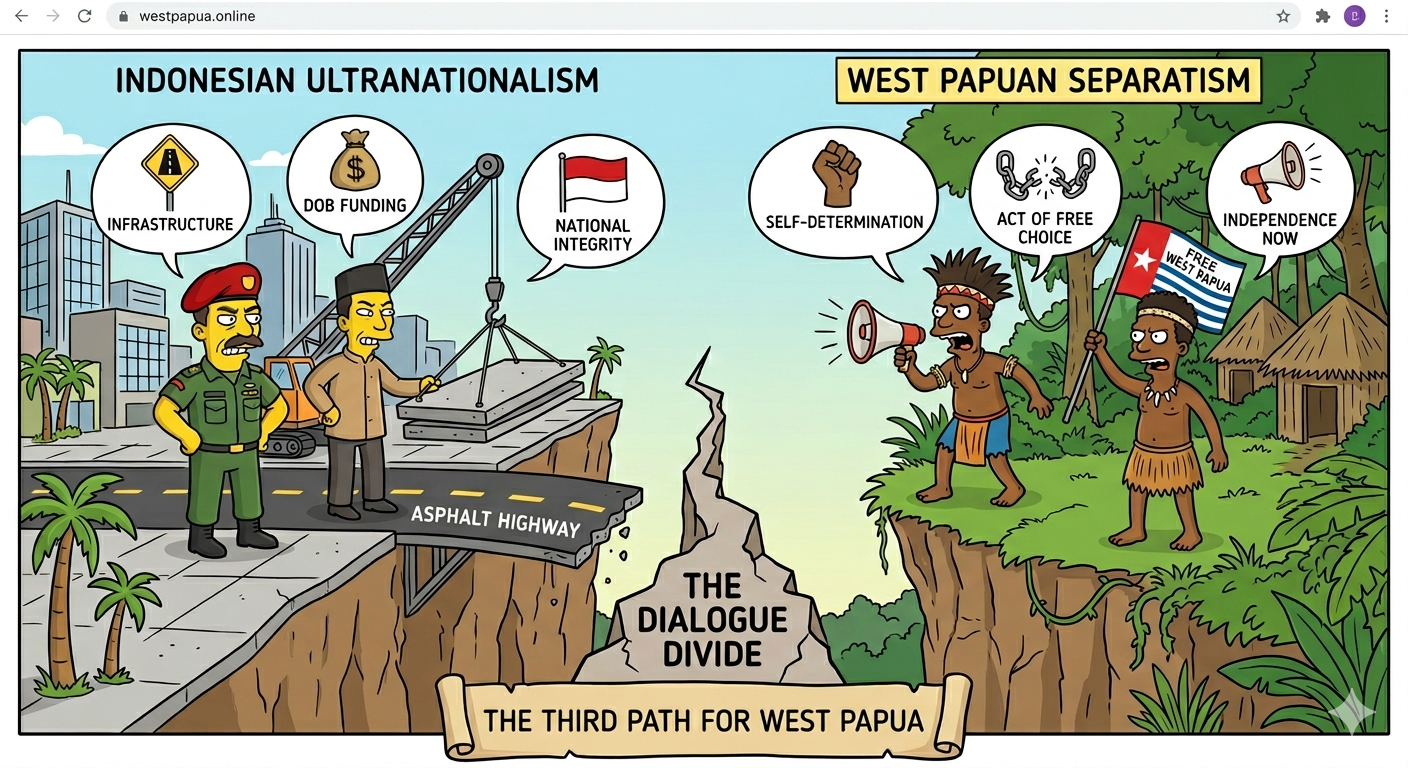
The discourse surrounding West Papua is frequently trapped in a sterile, violent binary that stifles genuine progress. On one side stands a rigid Indonesian ultranationalism that views the territory solely through the lens of Westphalian sovereignty and “National Strategic Projects”. On the other is a separatist movement that, while rooted in genuine historical grievance and claims of self-determination, often faces internal fragmentation and contributes to the devastating consequences of prolonged armed conflict.
To objectively understand the “Papuan Problem” is to recognize that neither of these poles serves the fundamental interests of the Indigenous Papuans (Orang Asli Papua). A critical analysis reveals that the true path forward lies in a radical commitment to human rights, environmental justice, and genuine indigenous dignity that transcends the state-vs-separatist struggle.
I. The Failure of “Asphalt Diplomacy” and Developmentalism
Jakarta’s primary failure over the last several years has been the assumption that material development can substitute for political dignity. This “developmentalist” paradigm focused on the Trans-Papua Highway and high-speed infrastructure that often acts as a “Gray-zone” tactic to secure territorial control rather than local welfare.
- Economic Displacement: Infrastructure often facilitates a migrant-dominated economy, leaving indigenous Papuans marginalized in their own markets.
- The PSN Pretext: National Strategic Projects (PSN) are frequently used as a legal shield to bypass the Free, Prior, and Informed Consent (FPIC) of indigenous tribes.
- Systematic Land Grabbing: In regions like Merauke, the implementation of mega-projects has led to what many describe as systematic land grabbing, where indigenous land is redesignated for industrial agriculture without meaningful consultation.
- The Ecological Toll: Large-scale nickel mining and agribusiness threaten the “lungs of the earth,” which are central to Papuan identity and survival.
II. Case Study: The Merauke Integrated Food and Energy Estate (MIFEE)
The Merauke region serves as a grim laboratory for the “development-security nexus”. Originally launched over a decade ago and revitalized in 2024-2026, the food estate project illustrates the human cost of “National Strategic Projects”.
- Destruction of Customary (Ulayat) Lands: Thousands of hectares of forest and savannah, traditionally used by the Marind people for hunting and sago cultivation, have been converted into industrial monocultures.
- Forced Modernization: Indigenous communities are often “persuaded” to release their land through military-guarded “socialization” meetings where dissent is viewed as an obstruction to national security.
- The Illusion of Employment: While projects promise jobs, most indigenous people lack the technical training for industrial agriculture, leading to the mass importation of laborers and further demographic marginalization.
III. The Erosion of Genuine Autonomy (Otsus)
The “Special Autonomy” (Otsus) framework was originally intended to protect indigenous rights and offer a “middle way”. However, recent legal shifts have significantly undermined this promise.
- Centralization of Governance: The 2021 amendments to the Otsus Law are increasingly viewed as an erosion of Papuan autonomy, deepening the centralization of governance in Jakarta.
- Weakening Regional Bodies: These reforms have weakened regional bodies like the Papuan People’s Assembly (MRP) and tightened Jakarta’s control over local political structures and resources.
- Administrative Fragmentation: The creation of new provinces (DOB) was marketed as a way to bring services closer to the people, but critics argue it was a strategic move to dilute Papuan political unity.
- Lack of Accountability: While the government touts the disbursement of funds, accountability mechanisms remain broken, and indigenous representative bodies have seen their powers substantively stripped.
IV. The Trap of Separatist Conflict and Militarization
While the desire for self-determination is a response to historical trauma, the armed conflict between security forces and separatist groups (TPNPB) has created a humanitarian catastrophe that primarily harms civilians.
- Internal Displacement: As of mid-2026, it is estimated that over 100,000 Papuans remain internally displaced (IDPs) due to ongoing conflict.
- The Development-Security Nexus: The designation of large agribusiness schemes as “National Strategic Projects” has led to increased military involvement to “secure” these projects.
- The Cycle of Violence: Armed actions by separatist groups provide the state with a justification for further militarization, creating a “security approach” that suffocates peaceful civil society.
- Humanitarian Crisis: IDPs suffer from a lack of food, clean water, and medicine, yet the government often limits international humanitarian access to these groups.
V. Humanitarian Forensics: Nduga and Intan Jaya
The highland regencies of Nduga and Intan Jaya have become the epicenter of a silent humanitarian disaster. Since 2018, the escalation of conflict has forced entire villages into the forests.
- Education and Healthcare Collapse: With schools and clinics often occupied by security forces or destroyed in crossfire, a generation of Papuan children is growing up without basic services.
- The Stigma of the Refugee: Displaced Papuans are frequently viewed with suspicion by the state, with humanitarian aid sometimes blocked to prevent it from “reaching the rebels,” leaving thousands in a state of chronic malnutrition.
VI. The “Gray-Zone” of Information and Civic Space
A major hurdle to an objective solution is the weaponization of labels and the narrowing of the civic space.
- Nationalist Rhetoric: Indonesian ultranationalists often label human rights defenders as “separatists” to justify criminalization.
- Legal Intimidation: Regulations like the ITE Law and the Criminal Code are frequently used to limit public criticism and narrow the civic space for human rights advocacy.
- Separatist Pressure: Conversely, pro-independence hardliners may dismiss any Papuan seeking peaceful reform or working within the legal framework as a “government puppet”.
- Information Warfare: Journalists in Papua continue to face intimidation, making it difficult for the truth regarding human rights violations to emerge.
VII. Environmental Injustice as a Tool of Control
For the indigenous Papuan, the environment is not a “resource” but the foundation of their culture and spirituality.
- Carbon-Reliance and Conflict: Research suggests that Indonesia’s reliance on carbon-heavy resources in Papua (mining and LNG) creates a structural necessity for state control, leading to the suppression of indigenous land rights.
- The Decarbonization Paradox: Even “green” initiatives, such as nickel mining for EV batteries, are being used as a pretext for new concessions in Papuan rainforests, often ignoring the ecological knowledge and rights of the local tribes.
VIII. A Paradigm Shift: Dignity over Sovereignty
To support the indigenous people objectively, the global and national community must prioritize Humanitarian and Environmental Outcomes over territorial or ideological claims.
| Feature | Ultranationalist View | Separatist View | The Indigenous-Centric Path |
| Priority | Territorial Integrity | Total Independence | Human Dignity & Rights |
| Land | State Asset | Political Frontier | Ancestral Heritage |
| Security | Military Presence | Armed Struggle | Humanitarian Pause |
| Autonomy | Bureaucratic Tool | Deception | Genuine Empowerment |
IX. Conclusion: The Way Forward
Winning “hearts and minds” cannot be achieved through a transaction of asphalt for loyalty. To bridge the chasm of trust, the Indonesian government must move beyond a “security and infrastructure” approach.
The way forward requires:
- Genuine, Inclusive Dialogue: Engaging with indigenous leaders as equal partners rather than subjects of development.
- Humanitarian Pause: Ceasing excessive military presence in civilian areas to allow for the return of displaced persons.
- Protection of Customary Land: Prioritizing the ecological and cultural integrity of Papua over extractive industry gains.
- Restoration of Autonomy: Returning to a version of Special Autonomy that genuinely empowers local representative bodies.
True advocacy for West Papua must be anti-separatist and favoring peaceful, legal resolution, but also firmly anti-injustice. It must reject the violence of the rebel and the oppression of the state, focusing instead on the right of the indigenous Papuan to live in safety and dignity.
References
- Journal of National Paradigm-Based Resilience Strategy. (2026). Analysis of the demonstration of the Indonesian house of representatives’ allowances in 2025. 2(1).
- Bahar, A., et al. (2025). Amnesty International Indonesia’s strategy for mainstreaming human rights in the 2024 presidential election campaign. Journal of Indonesian Social and Political Issues, 6(1).
- Amnesty International Indonesia. (2025). Amnesty International beberkan 36 video kekerasan polisi di demo Agustus lalu.
- Mulyono, H. I., et al. (2025). The impact of government expenditure on improving the quality of human development in Papua Province. Society, 13(2), 1158-1173.
- Pamganamamula, M. (2026). A route to self-determination: Empowering the West Papuan region through targeted Special Autonomy Law reforms. Loyola University Chicago International Law Review, 22(1), 84-110.
- Smith, J., & Williams, K. (2026). Does decarbonization undermine carbon-resource reliant peace? Exploring the resilience of Aceh and Papua’s contrast. White Rose Research Online.
- Surri, G., & Alfianto, N. (2025). The pretext of national strategic projects in the palm oil industry: A juridical analysis of massive deforestation and human rights violations in Papua. International Journal of Bakti Olahraga, Sosial, dan Ekonomi, 1(1).
- Westpapua.online Editorial. (2026). The Third Path for West Papua: Transcending the Binary of Ultranationalism and Separatism.
W
Categories
Articles, Separatism, West Papua Development, West Papua Separatists

West Papua View All
This Blog has gone through many obstacles and attacks from violent Free West Papua separatist supporters and ultra nationalist Indonesian since 2007. However, it has remained throughout a time devouring thoughts of how to bring peace to Papua and West Papua provinces of Indonesia.

