The Turning Point: Why We Can No Longer Silent Our Critique
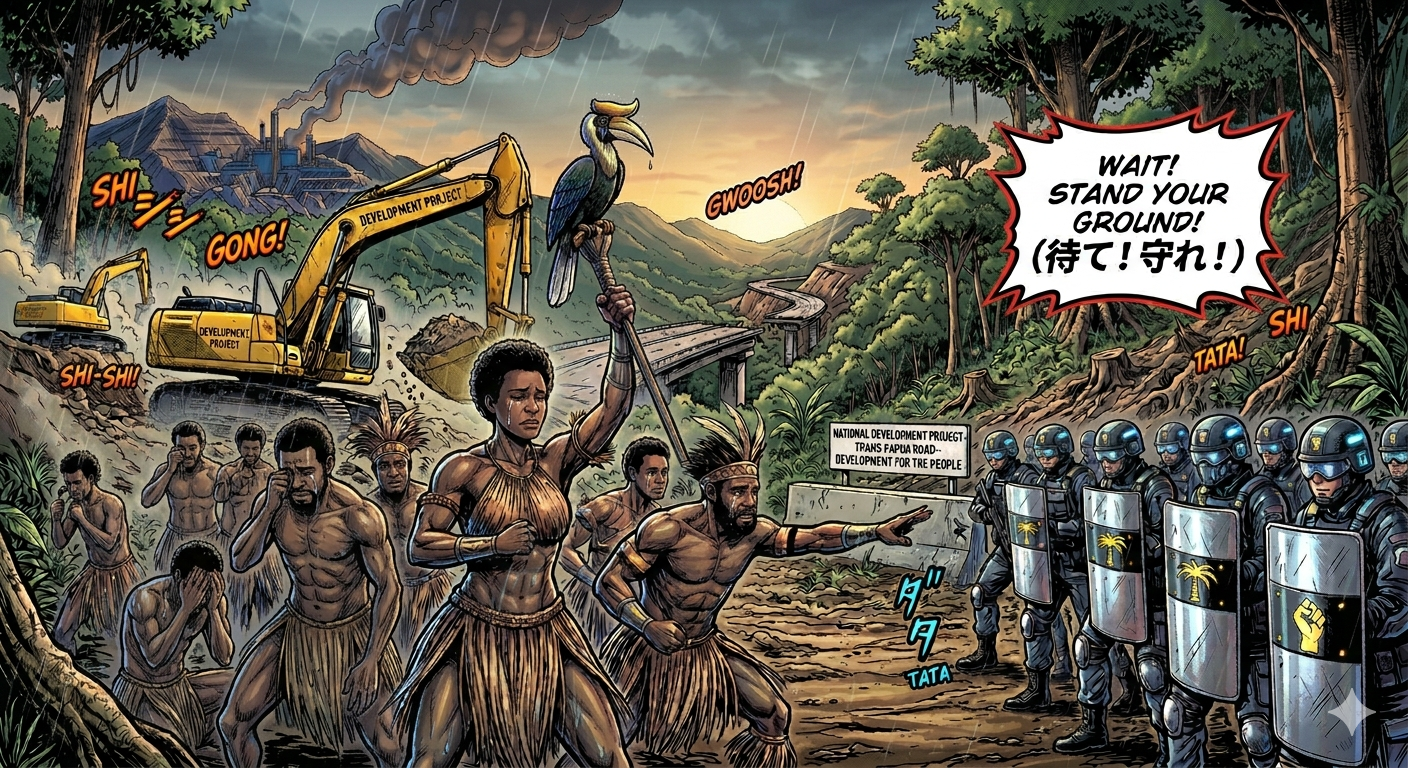
For years, westpapua.online operated on the belief that economic integration and state-led modernization were the clearest pathways to prosperity for the people of West Papua. We consistently published articles in support of the Indonesian government’s development agenda, genuinely hoping that new infrastructure, increased budgets, and national connectivity would alleviate poverty and uplift local communities.
However, the aggressive rollout of National Strategic Projects (PSN—Proyek Strategis Nasional) has forced a profound and unavoidable reckoning. What was promised as “development” has manifested as a destructive force that tears at the very fabric of Papuan existence. Vast swaths of ancestral forests have been cleared, sacred lands desecrated, and traditional food systems destroyed to make way for massive corporate agricultural and extractive mega-projects. When development actively dismantles the culture, identity, and basic survival of the indigenous Papuan people, it ceases to be progress, it becomes a tragedy.
As a platform dedicated to the reality of West Papua, we can no longer justify blind optimism. westpapua.online has come to realize that to truly stand with the Papuan people, we must critically evaluate and challenge the current trajectory of Jakarta’s policies. Below is an analytical look at why Indonesia’s development-first approach is failing West Papua, and why a radical shift in paradigm is urgently needed.
The Illusion of Progress: Why Indonesia’s Development-First Approach is Failing West Papua
For decades, Jakarta’s blueprint for West Papua has been built on a single, unwavering premise: that massive economic development can cure deep-rooted political and social unrest. By pouring trillions of rupiah into infrastructure, highways, and special economic zones, the Indonesian government has consistently presented itself as a benevolent modernizer (Saunders et al., 2024).
However, beneath the gleaming asphalt of the Trans-Papua Highway lies a starkly different reality. Jakarta’s policy of “developmentalism” is increasingly viewed by critics as a smoke screen that masks systemic human rights abuses, economic marginalization, and the erosion of indigenous Papuan identity (Harvey, 2015; Taliawo, 2022). By prioritizing physical infrastructure over human dignity, the government is not resolving the conflict in West Papua, it is fueling it (Saunders et al., 2024).
Infrastructure for Whom? The Mechanics of Exclusion and Destruction
The centerpiece of Indonesia’s strategy is infrastructure and large-scale land transformation under the PSN banner. While the Trans-Papua Highway and mega-agricultural estates were promised as gateways to food security and connectivity, their real-world impact on indigenous Papuans has been devastating (Harvey, 2015).
- Destruction of Basic Life Systems: Mega-projects like the Merauke Integrated Food and Energy Estate (MIFEE) and subsequent eco-spatial PSN developments have cleared hundreds of thousands of hectares of custom forests. This directly obliterates the sago forests and hunting grounds that form the baseline of Papuan nutrition and economic independence.
- The Influx of Migrant Labor: Large-scale development projects rarely utilize local Papuan labor, citing a lack of technical skills. Instead, they bring in thousands of skilled and semi-skilled workers from other Indonesian islands.
- Demographic Shifting and Cultural Erosion: This influx accelerates “spontaneous migration,” rapidly turning indigenous Papuans into a demographic minority. As ancestral forests are replaced by commercial monocultures, the deep spiritual and cultural connection Papuans hold with their land is systematically severed (Taliawo, 2022).
The government boasts of regional GDP growth, but this growth is highly extractive. The profits from West Papua’s immense natural wealth; gold, copper, gas, and timber, flow directly back to corporate boardrooms in Jakarta or multinational headquarters, leaving locals to bear the brunt of environmental devastation and land dispossession (Baird, 2024; Saunders et al., 2024).
The Militarization of Development
Perhaps the most critical failure of Jakarta’s approach is the complete inability to separate development from security operations. In West Papua, a road or a corporate plantation is never just an economic asset; it is a conduit for military mobility (Harvey, 2015).
[Jakarta's Logic] -----> Massive Infrastructure Dev -----> Economic Integration -----> Peace [The Reality] -----> Land Grabs & Security Hubs -----> Local Resistance -----> Increased Militarization
To “protect” national strategic projects from local resistance, the government has steadily increased its security footprint. The creation of new administrative regions (pemekaran) has served as a convenient justification to build new military (Kodim) and police stations near project zones (Harvey, 2015).
Instead of fostering a sense of safety, this heavy-handed militarization has led to:
- Mass Displacement: Security sweeps against the West Papua National Liberation Army (TPNPB) regularly displace tens of thousands of innocent civilians, forcing them into the forests without access to food, healthcare, or education (Baird, 2024; Saunders et al., 2024).
- A Culture of Fear: The constant presence of armed personnel in everyday civilian life, from schools to marketplaces, creates an environment of surveillance, intimidation, and unlawful violence (Harvey, 2015).
Silencing the Symptom, Ignoring the Cause
Jakarta’s stubborn focus on economic indicators is a deliberate attempt to bypass the actual core of the Papuan grievance: political self-determination and historical injustice (Saunders et al., 2024; Taliawo, 2022).
The 1969 “Act of Free Choice,” which formalized Papua’s integration into Indonesia, is widely criticized by Papuans as a sham conducted under military coercion (Saunders et al., 2024). By treating West Papua solely as a regional development issue, Jakarta treats the symptoms while aggressively silencing anyone who speaks to the root cause (Harvey, 2015; Taliawo, 2022).
Activists, journalists, and students who voice dissent against PSN land grabs face immediate suppression, treason (makar) charges, or arbitrary detention (Baird, 2024; Harvey, 2015). Meanwhile, international journalists and human rights observers remain effectively restricted from freely entering the region, turning West Papua into a geopolitical information black hole (Harvey, 2015).
Conclusion: A Paradigm Shift is Urgent
If the Indonesian government genuinely wishes to see peace in West Papua, it must abandon the arrogant assumption that Jakarta knows what is best for Papuans.
True development cannot be measured in kilometers of asphalt, hectares of oil palm, or the extraction of tons of ore. It must be measured by the freedom, safety, and self-determination of the people living on that land.
Jakarta must halt its security-heavy approach, halt destructive PSN projects that do not have the free, prior, and informed consent of indigenous landowners, and commit to an unconditional dialogue with Papuan leaders (Taliawo, 2022). Until the government addresses historical wounds and respects the indigenous custodians of the land, its multi-trillion rupiah development projects will remain nothing more than a monument to structural oppression.
References
Baird, N. (2024). The Universal Periodic Review and West Papua: Beyond Invisibility? International Journal on Minority and Group Rights, 32(1), 24-60. https://doi.org/10.1163/15718115-bja10158
Harvey, G. (2015). THE PRICE OF PROTEST IN WEST PAPUA. Griffith Journal of Law & Human Dignity, 3(1). https://doi.org/10.69970/gjlhd.v3i1.665
Saunders, S. H., Sherwood, A., & Whyte, D. (2024). Autonomy over Life: The Struggle against Capitalist Development in West Papua. State Crime Journal, 13(2). https://doi.org/10.13169/statecrime.13.2.0173
Taliawo, R. G. (2022). The Indonesianization of West Papua: Development of Indonesia’s Attitudes and Policies towards West Papua and the Dynamics of the Papua Freedom Movement. Journal of Humanities and Social Sciences Studies, 4(2), 71-83. https://doi.org/10.32996/jhsss.2022.4.2.10
Categories

West Papua View All
This Blog has gone through many obstacles and attacks from violent Free West Papua separatist supporters and ultra nationalist Indonesian since 2007. However, it has remained throughout a time devouring thoughts of how to bring peace to Papua and West Papua provinces of Indonesia.

